Why 90% of Drug Candidates Fail and How AI Is Fixing the Broken Funnel
By screening millions of compounds computationally before lab work begins, Rayca Precision is shortening the path from molecular design to oncology treatments.

Drug Discovery Has Been Slowed by Fragmentation Rather Than a Lack of Science
Modern drug discovery is burdened by a funnel that breaks long before a molecule reaches the clinic. Targets are chosen with incomplete biological context. Molecules are optimized through slow iteration. Experimental results often fail to feed back into design systems in a meaningful way. The result is a process that consumes time and capital while discarding valuable insight at each stage.
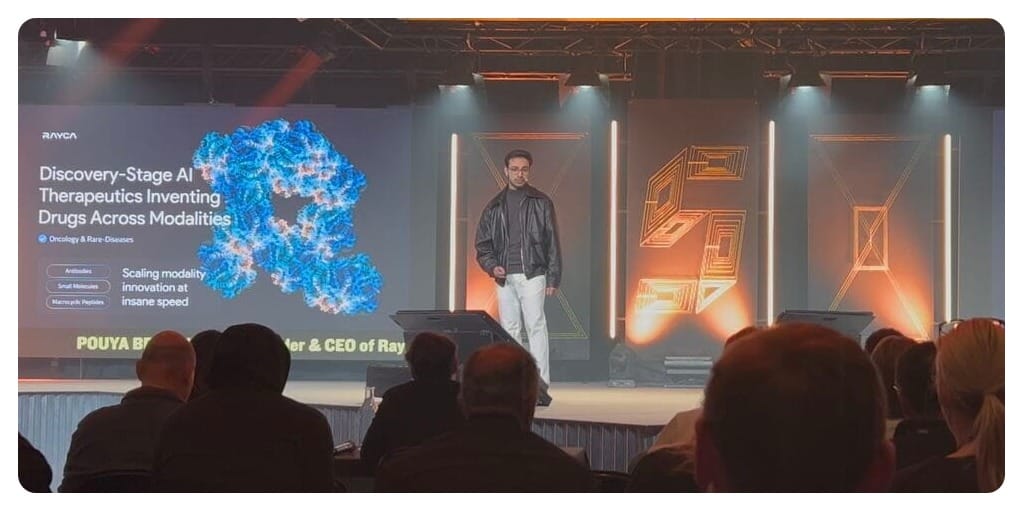
The company, Rayca Precision, is being built around a different premise: that discovery should begin with integrated computation, not downstream correction. The company operates as a discovery-stage AI biotech focused on generating early assets that can be validated experimentally and advanced by partners. Its work centers on oncology and rare disease targets where biological complexity has historically made success difficult.
“We can start with analyzing a drug target structurally and figure out what the pockets are, what the interaction interfaces are that we can actually target with a proper molecule and modality,” says founder Pouya Behrouzi. That structural starting point shapes everything that follows, from molecular generation to experimental design.
Rather than positioning AI as an assistive tool layered onto conventional workflows, the company treats computation as the backbone of discovery. High-performance infrastructure, scalable simulation pipelines, and generative models are assembled to evaluate millions of compounds rapidly, narrowing the field before lab work begins.

Computational Scale Is Changing What Is Possible at the Discovery Stage
Several shifts have converged to make this approach viable. GPU access is no longer limited to a few institutions. Biological and chemical datasets are better curated and more accessible. Generative models trained on experimentally validated data can now propose molecules with meaningful structural relevance.
“It was not possible before, and now we have all these technology stacks that we can put together and make this happen,” Behrouzi explains. The company’s platform runs large-scale simulations, physics-based modelling, and inference workflows that would have been prohibitively slow or expensive even a few years ago.
What differentiates execution is not access to models alone, but how quickly insights cycle back into design. Experimental readouts from partner labs are logged and reintegrated, allowing the system to learn iteratively rather than operate as a one-off generator. This creates a continuous loop between computation and biology.
The output is not a finished drug, but a rigorously packaged preclinical asset. Each molecule is supported by structural rationale, computational evidence, and laboratory signals that increase confidence for downstream development. For pharmaceutical and biotech partners, this shifts early risk away from intuition and toward evidence.
Better Early Decisions Determine Which Therapies Ever Reach Patients
The long-term impact of this approach lies in what never advances. By increasing confidence earlier, fewer weak candidates enter costly preclinical and clinical stages. Capital can be directed toward assets with a higher probability of success, particularly in complex disease areas.
“Eventually coming up with better treatments and more targeted therapeutics that can reduce side effects in oncology is the impact we care about,” Behrouzi says. While the company does not conduct clinical development itself, its goal is to accelerate the handoff to organizations that do.
The founding team’s strength lies in its ability to operate through uncertainty together. Years of collaboration across technical and operational challenges have shaped a culture focused on disciplined execution rather than rapid signalling. That stability matters in a field defined by long timelines and high attrition.
The company’s next phase centers on expanding its discovery pipeline and validating AI-generated molecules at a greater scale. As deal structures around AI-discovered assets mature, the team expects faster feedback between science, capital, and clinical potential.
“We believe that this combination of infrastructure, models, and execution can help fix parts of the broken discovery funnel,” Behrouzi says. The bet is that rebuilding discovery from first principles will ultimately shorten the path between insight and impact.
About Flashpoint POV Spotlights
Flashpoint Global produces each Founder POV Spotlight using its proprietary category leadership framework. Every Spotlight begins with a Future Narrative session, where a founder’s POV is clarified and operationalized as the lens through which new categories are built. The result is content that moves founders beyond product messaging and into the role of category leader, helping the market understand the problem, the stakes, and the future being created.
If you are a founder building a new category, learn more.