Slush 100 2026: Goldfish Wins the €500K No-Strings Prize, Plus the Finalists and the Full Top 20
Goldfish took Slush 100 and the first equity-free prize in the competition’s history, beating finalists TerraSpark and Sqwish Labs on the Founder Stage in Helsinki. Here is the winner, the finalists, and what all 20 semifinalists are building.

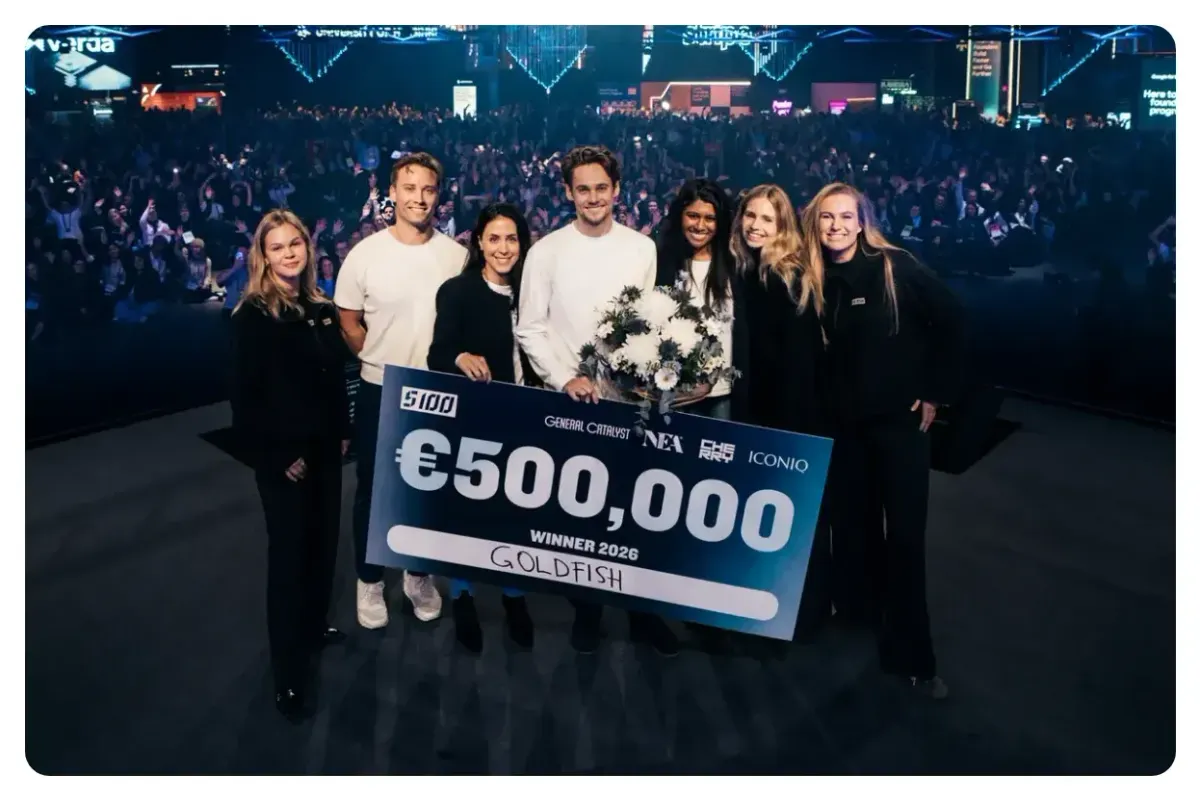
Slush returned to Helsinki on November 18 and 19 under the banner "Bet on Europe," with organizers trimming the audience by 10 percent to keep the room weighted toward early-stage founders and the investors who back them. Slush put the gathering at more than 12,000 people, with startups from over 70 countries and investors representing €4 trillion in assets under management. The biggest change was to Slush 100 itself. After four years of awarding a €1 million venture investment, the competition switched to €500,000 with no equity taken, and a record 1,400-plus startups applied. One hundred were shortlisted, 20 pitched in the semifinals on day one, and three reached the Founder Stage final.
You just pitched to investors, judges and customers. Which number did you give them?
Give your startup a real business line. Slingshot sets one up in two minutes, priced like a coffee, month to month. It leaves when you leave.
The Slush 100 Winner
Goldfish [AI] won Slush 100 on the Founder Stage in Helsinki, taking home €500,000 with no equity attached. It is the first time in the competition's history that the prize has been equity-free, and Goldfish came through a field of more than 1,400 applicants to claim it. The product is a personal AI memory that lives on your computer, remembers what you have been working on, and drafts replies in your own tone from any app with a single key press. Swedish founders Joel Edholm and Kaspian Jakobsson built it during Entrepreneur First's residency in San Francisco, opened early access in June, and have since seen it used more than a million times. They return to Slush 2027 as main stage speakers.
The Finalists
TerraSpark [Climate / Energy] reached the Slush 100 final with a plan to collect solar power in orbit and beam it to Earth by radio frequency, starting with wireless power pilots on the ground. CEO Jasper Deprez leads the Luxembourg company alongside CTO Sanjay Vijendran, who ran the European Space Agency's Solaris programme, and COO Matthias Laug, a co-founder of Tier Mobility. TerraSpark closed a €5.4 million pre-seed led by Daphni, and its first in-space transmission test is booked on a SpaceX rideshare for early 2027, with space-to-Earth power targeted for 2028.
Sqwish Labs [AI] reached the final with what it calls System 1 for AI: small, fast decision models that choose between options instead of writing text, usable off the shelf or tuned on a customer's own data. Cambridge-trained founders Ushnish Sengupta and Federica Freddi released the kettei model family and announced a $3 million pre-seed the week of Slush.
Standouts From the Top 20
CURA [Climate / Energy] is going after cement, the source of roughly 8% of global CO₂ emissions. Co-founder Sabrina Scott's team uses electricity and water to split limestone into a low-carbon calcium feedstock and a concentrated CO₂ stream before it ever reaches the kiln, with the potential to cut emissions by up to 85%. In its first year the company commissioned a 5 kg per day mini-pilot, secured US$10 million in financing, and grew from three people to 20. A 100-tonne per year pilot with Grand Forks Concrete in Taber, Alberta is planned for 2027, a 30,000-tonne commercial demonstration is targeted for 2028, and MOUs are in place with TITAN Group, ACCIONA, Aecon and Fast + Epp. CURA also won PITCH at Web Summit Vancouver this year.
Quadrivia [Healthtech / AI] buys small, profitable healthcare providers with long-running revenue and rebuilds their operations on Q, its own AI operating system. Founder and CEO Ali Parsa reports €6 million in 2026 revenue, up from zero in 2025, with $15 million of acquired annual revenue and a $50 million acquisition pipeline across the US and UK. The cash flow goes back into more acquisitions and the platform.
Monako [Hardware] is building Monako Glass, a full Linux computer in a pair of glasses with an open operating system developers can build on. Founder Candy Liu launched the presale on X in June with no paid media and took 1,000 orders in 72 hours, then 2,530 orders in 39 days, worth more than $1 million. The company has raised $4 million from MiraclePlus and Sense Capital, with Sunny Optical joining as a strategic investor and hardware co-developer on Qualcomm's AR1 platform. First engineering units are expected in December, with a CES 2027 debut to follow.
Tekton Dynamics [AI / Industrial] turns the robots fabricators already own into autonomous welders with its own AI software and sensors, so no shop has to rip out existing hardware. Founder and CEO Max Ahrens has several design partners signed, and the system has already welded their parts in Tekton's lab and passed their quality checks. On-site deployments begin in January 2027 and the calendar is full through the first quarter. The team is made up of AI and robotics PhDs from Oxford and Cambridge.
Allude [AI / Industrial] is building what founder and CEO Eva Debette calls a brain for factories, capturing the know-how of experienced operators automatically before they retire or move on. The pre-seed company already works with X-FAB, Mars, Renault and Thales, counts angels from OpenAI, Palantir and Hugging Face among its backers, and is aiming for $1 million in ARR within six months.
Marentis [AI / Industrial] connects machine data, technical documentation and engineering knowledge so production engineers can diagnose problems faster and keep what they learn. Founder and CEO Stephan Hotz has a first rollout under way at a major automotive OEM, with several more large manufacturers in proof of value projects.
Morpheus [AI / Fintech] builds context for AI agents, starting with private market funds. Founder and CEO Thomas Panton says benchmarking across eight pilots showed agents performing nearly 100% more accurately at up to 12 times lower cost, and the company has built a pipeline of more than 85 funds in six months.
The Rest of the Top 20
Upside Robotics [Robotics / AgTech] builds solar-powered autonomous robots that feed corn crops small, precise doses of fertilizer through the season. Founders Jana Tian and Sam Dugan raised a $7.5 million seed led by Plural and are operating across more than 3,000 acres in Ontario.
BTRY [Hardware] is an ETH Zurich and Empa spinout making ultra-thin solid-state batteries that charge in about a minute and run from -40 to 150°C. It closed an oversubscribed $5.7 million seed to industrialize production.
Pally [AI] is a personal assistant you reach by text message, connected to your inbox, calendar and files. Founders Haz Hubble and Wyatt Lansford raised a $5.2 million seed led by Cyber Fund and Y Combinator.
Nextesy [AI / Enterprise] automates accounting, payroll and back-office work for Swiss SMEs, freelancers and fiduciaries. Co-CEOs Dario Fazlic and Milan Kuzmanovic lead the Zurich company, which passed 2,000 active customers this summer.
InLoop Robotics [Robotics / Hardware] rents out robot workers by the month for warehouse jobs like packing, kitting and picking, on a flat fee with no upfront hardware cost. When a robot gets stuck, a remote operator takes over in seconds and each intervention trains the model. The Munich-founded team is live in customer warehouses, with paid pilots running at more than 300 picks per hour.
MorphoAI [AI / Industrial] builds hardware foundation models that train on 3D CAD data and output assembly-level designs that meet engineering requirements. CEO Ayna Arora's team works between New York and London, draws on more than 40 research papers from MIT and Harvard, holds a £2.5 million grant from the UK's ARIA, and counts customers in robotics, energy equipment, data centers and medical devices.
DAIVIN! [Hardware] makes breathable oxygen from water with a wearable device meant to replace the steel tank, built for divers, soldiers and astronauts. Finnish founder Leo Kankkunen took the company through Y Combinator.
Nitroduck [Biotech / AgTech] delivers CRISPR through pollen so breeders can gene-edit any crop for flavour and disease resistance without pesticides. The Brno team is Y Combinator-backed.
GraceX [AI / Enterprise] builds a private, governed memory layer for enterprises that carries each source's permissions with it and masks sensitive data before any model sees it. The Rome team of serial founders raised €5 million in its first year.
Foundation Clinic [Healthtech] harmonizes a patient's scattered health records into one timeline a clinician can read, and runs its own clinics in Helsinki and Turku to prove the model.
Running a pitch competition, accelerator or demo day?
UpNext produces editorial showcases for innovation centres, accelerators and trade agencies, putting your cohort in front of a network of 150,000+ founders, investors and innovation leaders, with a direct introduction channel to every company. Talk to us about your next cohort.
Why It Matters for the UpNext Network
Taking the equity out of the prize changed who showed up. This year's Top 20 came from 11 countries and ranged from space-based solar and solid-state batteries to welding robots, gene-edited crops and smart glasses, alongside a wave of AI companies building memory and decision layers. Six of the 20 came through Y Combinator, and several reported paying customers, signed pilots or seven-figure presales before they reached the stage. The winner was a two-founder product that opened early access only five months before the final, which says a lot about how fast a team can now go from launch to winning Slush 100.
Slush also published research with a claim founders on the circuit should note: startups that attend are 3.5 times likelier to raise funding and seven times likelier to land a top-tier VC on their cap table. For anyone weighing which events earn a place on next year's calendar, the Top 20 above is a good picture of what the room looks like.