
How an Ex-Google Engineer Built an AI Platform to Fix Early-Stage Startup Funding
When Chris Coomes was handed 100 startup applications with no way to rank them, he realized the early-stage funding ecosystem had not evolved in twenty years. He built X1 Pipeline, an AI-native platform whose investability score evaluates any startup, anywhere, on the same terms.

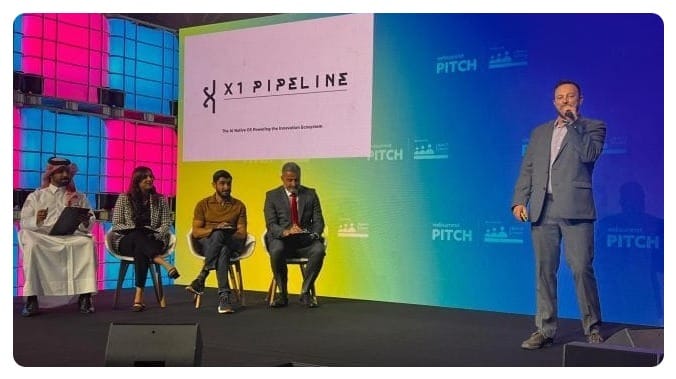
The tools connecting early-stage startups to investors have barely changed in twenty years. Founders still fill out TypeForms with sixty fields. Investors still sort through hundreds of disconnected applications with no reliable way to rank them. The platforms built to solve this were designed for investors already inside the system, and none of them talk to each other. Chris Coomes saw all of this firsthand, first as a program manager at Google, then as an angel investor who could not remember the first startup application he reviewed by the time he reached the twentieth. He built X1 Pipeline to fix it.
The engineer who couldn’t let inefficiency win
Coomes grew up in Akron, Ohio, wanting to be president of the United States. He wanted to make real change without being corrupted by outside influence, to do the right thing regardless of who was pushing back. That ambition never quite left him. It just took a long route to find its form.
He studied mechanical and industrial engineering at the University of Toledo, went into consulting for OEMs, became an engineering manager at Amazon, then spent eight years at Google building manufacturing automation and robotics across its data centres and logistics facilities, working alongside the person who would later become his co-founder at X1 Pipeline. When Google relocated the team to Seattle, Coomes and his family decided they were done. His wife is Czech, and they had come to love Europe. He quit, moved to Ljubljana, Slovenia, and became an angel investor.
That is when the real problem revealed itself.
The hundred applications he could not read
Coomes was new to an angel investor group when they gave him access to their software with more than 100 startup applications and asked him to select 10 to pitch at an upcoming event. He got through twenty. By the time he reached the twentieth, he could not remember what the first company did. Every application had dozens of typed questions, documents in different formats, pages upon pages of text, none of it current, no reliable way to rank any of it. “I said, well, there’s a better way. We can fix this,” he recalls. “Startup founders should be building instead of filling out forms constantly.”
As a Lean Six Sigma black belt who spent nearly a decade engineering process efficiency inside several of the world’s most complex organizations, Coomes could not accept the status quo. The tools the innovation ecosystem relied on had been built for a pre-AI world and had barely evolved in two decades. Nobody had fixed the underlying infrastructure.
X1 Pipeline is built around the investability score, an AI-driven evaluation that assesses startups across nine indicators to produce a real-time measure of financial health, team strength, market traction, and more. Coomes likens it to a credit score for companies. The score holds stable unless something fundamental changes, and the report it generates tells founders exactly what an investor would flag and precisely what to fix.
The AI was trained to think like an investor, and Coomes is clear that it is not a gentle one. “It tells you exactly what’s up,” he says. “Your friends and family say, oh, that’s the coolest company. Our investor says you’ll probably fail unless you fix all of this.” Founders come back repeatedly, running their score, acting on the report, tracking the improvement. Several have told Coomes the feedback matched exactly what investors said, which meant they already had the answers prepared.
The companies that should not get shelved
Coomes has known strong startups that failed because they could not get funding, not because the idea was bad, but because they lacked the network. An edtech founder who came out of education has never had a conversation with a venture capitalist and they shouldn’t have to build an investor network instead of building their company. A strong team in a region investors do not fly to only gets evaluated, if at all, by whoever happens to find their deck. The investability score evaluates every company on the same terms regardless of geography, background, or warm introductions. Every startup on X1 can be found by investors, a big change from today when investors only find startups who apply directly to them. A startup shouldn’t have to fill out thousands of investor forms to be found. “There shouldn’t be world changing things that are being shelved due to a founder not having a VC network and no way to systematically show off how amazing their company is” Coomes says. Over 10,000 startups have been evaluated on the platform through organic growth alone.
He is raising a seed round to scale the user base, with an AI research assistant launching inside the platform as the next major feature. Coomes says they know they made it when the X1 profile becomes a standard field for social sharing, the wayevery application asks for your LinkedIn and Meta profiles.
The kid from Akron who wanted to fix things without being corrupted by outside influence is still at it. He just found a different lever.
About Flashpoint POV Spotlights
Flashpoint Global produces each Founder POV Spotlight using its proprietary category leadership framework. Every Spotlight begins with a Future Narrative session, where a founder’s POV is clarified and operationalized as the lens through which new categories are built. The result is content that moves founders beyond product messaging and into the role of category leader, helping the market understand the problem, the stakes, and the future being created.
If you are a founder building a new category, learn more.