
Techarena 2026: Epiminds Wins + TOP46 Standouts
Techarena 2026 recap: How Epiminds won with AI-native marketing automation, plus the TOP46 finalists defining Sweden's next wave of tech companies.



Techarena 2026 had a different energy this year. Sharper. More grounded. The conversations weren't about pitching the future of AI—they were about building companies that can actually scale.
What stood out wasn't hype, but execution. The startups that made it to the TOP46 arrived with traction signals, defensible moats, and a realistic path to market leadership. You could feel the difference between tech ideas and tech companies—especially among the finalists, where founders were defending their approaches in front of investors who've backed category leaders.
And that's where Techarena cut through. Not as a showcase, but as a proving ground. The teams that advanced didn't just have compelling decks—they had compelling answers to the hard questions about go-to-market, competitive positioning, and unit economics. Epiminds' win wasn't surprising. Their AI-native marketing OS does something tangible: it deploys 20+ autonomous agents to automate performance marketing workflows at scale. That's not visionary. It's operational.
Below is a closer look at the winner and the cohort of startups that demonstrated the kind of clarity and conviction that gets deployed, not just funded.
Techarena 2026 - Winner
This year's Techarena competition surfaced Sweden's strongest cross-section of technical founders tackling real, category-defining problems—from AI-native infrastructure and climate tech to fintech, health tech, and enterprise software. Out of hundreds of applications, 46 startups were selected as finalists, with one team ultimately taking home the top prize.
What stood out wasn't hype, but execution. Epiminds demonstrated clear problem definition, strong technical foundations, and a credible path to adoption—offering a snapshot of where European early-stage innovation is heading next.
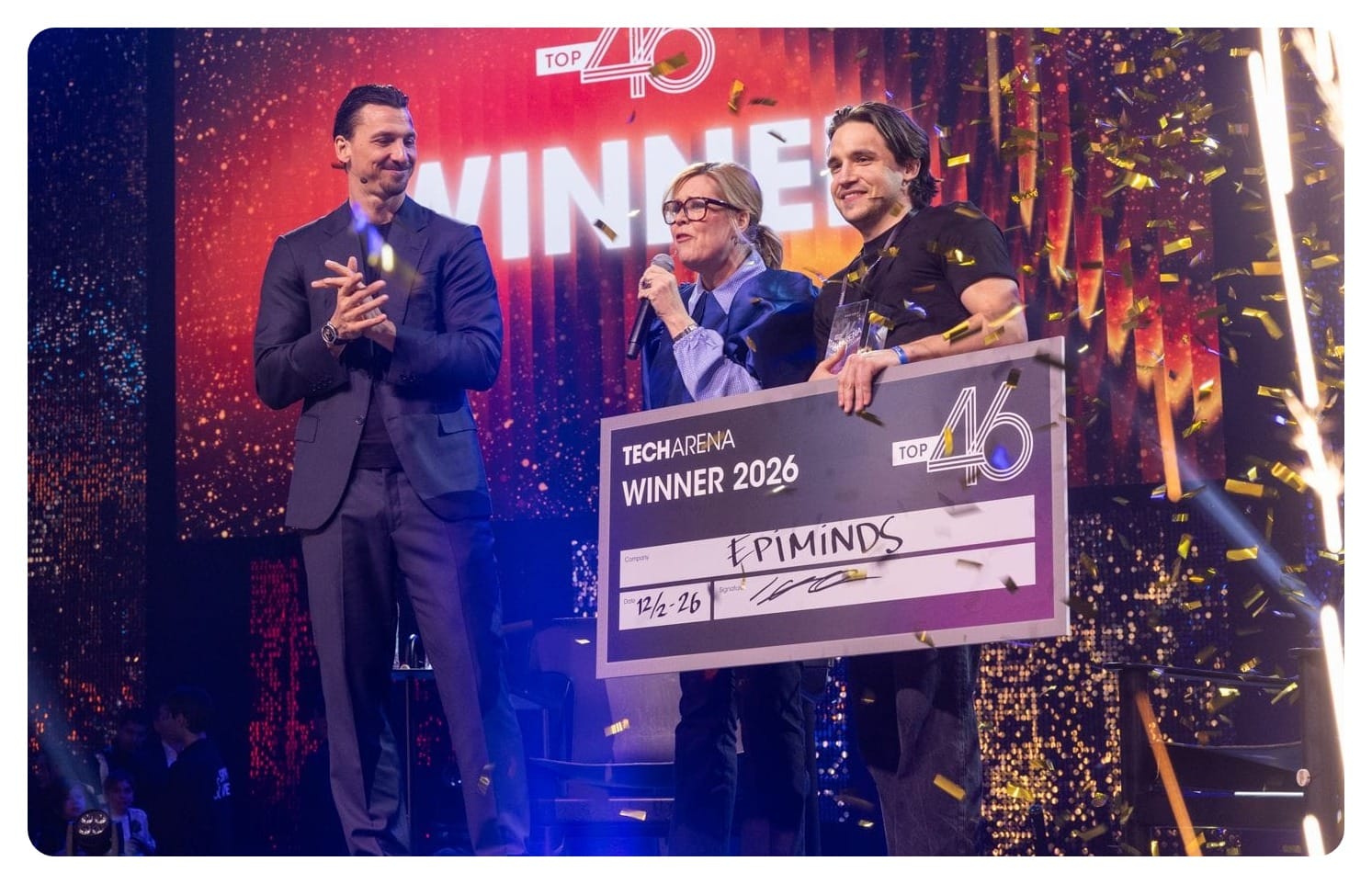
WINNER: EPIMINDS
Founders: Elias Malm & Mo Elkhidir
Pitch:
Epiminds is an AI-native marketing operating system that deploys autonomous agent teams to run data, creative, and strategy at scale. Led by an AI bot named Lucy, the platform handles analytics, campaign planning, copywriting, and execution across Google Ads, Meta Ads, and other channels—turning marketing teams into strategic decision-makers rather than tactical executors.
What stood out:
Moving from dashboards to autonomous execution in performance marketing. While most martech platforms offer optimization suggestions, Epiminds deploys over 20 specialized AI agents that collaborate to automate everything from reporting to creative briefs and ad set configuration. Lucy drafts and recommends complete campaigns but requires human approval before publishing—creating an augmented senior colleague rather than a black-box automation tool. The platform is platform-agnostic, orchestrating multiple ad platforms and data sources rather than locking customers into a single walled garden.
Traction:
$6.6 million seed round led by Lightspeed Venture Partners. Working with ~20 performance marketing agencies across the Nordics, Netherlands, and US, collectively representing over 200 brands. Reached ~$100k+ in CARR within the first 10-12 weeks of launch. Agencies report saving ~40% of time on routine marketing tasks.
Why they won Techarena 2026:
Combining deep marketing-ops expertise with cutting-edge AI engineering to solve a high-volume, capital-intensive problem where small efficiency gains translate into massive dollar savings. The founder-market fit is exceptional—Elias Malm (ex-Google marketing leader) and Mo Elkhidir (ex-Spotify AI engineer) bring exactly the credibility needed. They demonstrated rapid product-market fit with 16+ paying clients and >200 brands in under three months, and a clear "marketing OS" vision that resonated with judges seeking real-world AI impact at scale.
Techarena 2026 - Standout Startups
Beyond the winner, Techarena brought together Sweden's most promising tech founders building across AI, climate tech, fintech, health tech, and enterprise software. Not all made it to the final pitch stage, but the teams below stood out for their technical depth, market timing, and execution velocity.
What made them notable wasn't just the innovation—it was how clearly they articulated their go-to-market strategy, understood their competitive moat, and demonstrated early traction signals. These are the startups worth tracking as they move from early revenue to scale.

ÄIO
Founder: Nemailla Bonturi
Pitch:
ÄIO produces sustainable fats and oils through microbial fermentation, converting low-value industrial sidestreams into high-value lipids for food, cosmetics, and oleochemicals. The process uses 97% less land and 10x less water than conventional oil production, addressing supply instability in a $350B global market facing climate and geopolitical pressures.
What stood out:
This is infrastructure-level decoupling of the oils market from agriculture. ÄIO doesn't just optimize margins—it rewrites input economics by valorizing waste streams (dairy, sawdust sugars) through proprietary fermentation. The platform approach across three product lines (Encapsulated Oil, RedOil, ZymaLipid Complex) positions them as a materials supplier rather than a single-application play, enabling faster market penetration and diversified revenue.
Traction:
Three products at the market-ready stage with INCI registration for cosmetics. 120+ collaboration partners globally testing oils across industries. Scaled production from 1L to 10,000L with a food-grade pilot plant operational. Novel food permit submitted in Singapore. Over €11M raised in equity and grants. One patent filed, ready for 100,000L scale-up.
Why they made the TOP46:
The planet is running out of arable land while fat demand grows. ÄIO represents the shift from extraction to precision fermentation in commodity ingredients—a transition already proven in insulin and enzymes, now reaching the trillion-ton oils economy. With regulatory momentum building and cost curves dropping toward parity by 2027, they're positioned at the inflection point where bioprocessed materials move from premium to mass market.
AINOSTICS
Founder: Hojjat Azadbakht
Pitch:
AINOSTICS builds AI imaging platforms that transform routine MRI scans into early, automated diagnoses across major neurological diseases. Its flagship product, BR[AI]N, analyses standard brain scans and delivers clinically actionable insights within seconds, enabling earlier intervention and precision treatment.
What stood out:
Platform depth and regulatory ambition. BR[AI]N supports up to 10 major neurological conditions—including dementia, multiple sclerosis, epilepsy, traumatic brain injury, and brain tumours—using standard MRI, CT, and PET data. The system has received FDA Breakthrough Device Designation and demonstrates up to 92% accuracy in predicting Alzheimer’s disease years before clinical diagnosis. Unlike black-box AI tools, AINOSTICS emphasizes explainable, traceable outputs integrated directly into hospital workflows.
Traction:
AINOSTICS has validated its technology on over 100,000 imaging datasets and secured more than $10 million in non-dilutive funding. The platform has been piloted across multiple NHS hospitals and generated $1.5 million in revenue last year through collaborations with hospitals, research organizations, and pharma companies. It has also received over 10 international innovation awards and built partnerships across major imaging and healthcare networks.
Why they made the TOP46:
Neurological disorders represent a trillion-dollar burden in Europe alone, and emerging disease-modifying therapies require earlier, more precise diagnostics. AINOSTICS is positioning itself not as a single-condition tool, but as a neuro-diagnostics platform with regulatory momentum and companion diagnostic potential. It’s a clinically grounded AI company targeting one of healthcare’s most urgent unmet needs.
BrainLink
Founder: Dan Farahmand
Pitch:
BrainLink builds the world’s first remote, truly wireless intracranial pressure monitoring and treatment system, targeting millions of people living with hydrocephalus and other brain pressure disorders. The implantable ICP device connects to secure cloud software and clinician dashboards, enabling continuous, long-term monitoring and remote management without frequent hospital visits.
What stood out:
A medtech platform built from inside clinical experience. Dan’s background as a neurosurgeon shapes BrainLink’s approach to solving a core gap in neurological care: traditional pressure monitoring is invasive, episodic, and resource-intensive. The combination of wireless sensing, smartphone connectivity, and cloud access offers a step change in how clinicians diagnose and manage brain pressure.
Traction:
BrainLink has developed IP and completed hardware/software design. The platform is being validated with key opinion leaders and has signed initial customers and clinical partners in Europe. Public mentions from TechArena highlight it as a breakthrough innovation with a growing international profile.
Why they made the TOP46:
Brain pressure disorders like hydrocephalus affect millions globally and are underserved by current diagnostics. BrainLink’s wireless system enables continuous remote monitoring, reducing hospital burden and enabling earlier intervention. It’s a clinically grounded solution with real potential to shift standards of care and support future therapeutic integration.
Braive
Founder: Hermine Bonde Jahren
Pitch:
Braive is an evidence-based mental health treatment platform designed to help clinics and insurers deliver measurable outcomes at scale. The platform integrates structured digital treatment programs, psychometric testing, AI-supported documentation, and video care into a single workflow, enabling scalable, standardized, and trackable mental health treatment.
What stood out:
Braive is focused on treatment, not administration. While many digital health tools optimize scheduling or operations, Braive is built to deliver clinically validated care pathways that deliver measurable symptom reduction. The platform increases clinician capacity by up to 4x and demonstrates an 80% improvement in symptoms across 100,000 patients treated—backed by structured outcome tracking and research partnerships.
Traction:
Braive has supported over 100,000 patients and nearly tripled ARR from 2024 to 2025, reaching 23M SEK ARR. Through partnerships in Sweden and Norway, the company now reaches 40% of the occupational health market and has expanded beyond the Nordics with a large-scale partnership in India. The platform operates on a scalable per-clinician subscription model with 67% gross margins and MDR Class IIa status on track.
Why they made the TOP46:
Mental health systems face rising demand, limited clinician capacity, and increasing pressure to prove outcomes. Braive combines evidence-based treatment delivery with scalable SaaS infrastructure, positioning itself as a repeatable engine for standardized, high-quality mental healthcare across Europe and beyond.
CatchAll by NewsCatcher
Founder: Margaretha von Boetticher
Pitch:
CatchAll is a recall-first web search API built on NewsCatcher's proprietary index, designed to retrieve complete event coverage rather than ranked results. The system addresses workflows where missing information has consequences—regulatory monitoring, risk analysis, competitive intelligence—by exhausting topics instead of surfacing top matches.
What stood out:
This is a search rebuilt for completeness, not relevance. Standard search APIs are optimized for ranking and speed, returning the top few results. CatchAll inverts that—it's designed to find everything, then structure and deduplicate it. The distinction matters for AI agents and enterprise research where partial recall creates blind spots. The proprietary web index gives them end-to-end control over retrieval and extraction, enabling event-level structuring and live monitoring at scale.
Traction:
Y-Combinator-backed. Customers include the US Department of State, Samsung, the Armed Forces of Ukraine, Transparency International, and multiple Fortune 1000 and generative AI companies. December 2025 CatchAll launch generated 800+ signups and 4+ paying customers. Event coverage 3x higher recall and 60% higher F1 score than competitors.
Why they made the TOP46:
AI agents and enterprise intelligence systems inherit the limitations of the search infrastructure on which they're built. If the underlying API is optimized for speed and ranking, agents will always operate with incomplete information. CatchAll positions itself as the coverage layer for agentic workflows—the infrastructure that ensures nothing relevant is missed. As agents move from demos to production use in compliance, risk, and decision-critical contexts, exhaustive retrieval becomes table stakes. If they can demonstrate reliable recall at scale, this would become foundational infrastructure for the next generation of research and monitoring systems.
CHRP
Founder: Jeff Smith
Pitch:
CHRP measures cognitive and emotional readiness in real time by analyzing passive music listening behavior. The platform detects shifts in performance state before productivity declines or burnout sets in, giving individuals self-awareness and organizations an early-warning system for their workforce.
What stood out:
This is behavioral biometrics for mental state, derived from a signal people already generate. Rather than surveys or wearables that require active participation, CHRP instruments existing behavior—music choice becomes a proxy for readiness. The insight that music patterns shift before performance declines creates a leading indicator where most tools only measure lagging outcomes. Deployment across military, athletics, and enterprise shows the pattern holds across high-stakes contexts.
Traction:
Live deployments generating $100K+ ARR from paid pilots. Active users include U.S. Navy EOD units, Ohio State Wrestling, and self-insured employers in construction and staffing. Over 400 users are generating readiness data. Expanding to Nordic customers and scaling the NIL program across D1 athletics programs.
Why they made the TOP46:
Organizations spend billions managing human performance after problems surface—turnover, medical claims, accidents, and underperformance. CHRP addresses the measurement gap: there's no continuous, passive signal of cognitive readiness, as there is with heart rate variability for physical recovery. If music-listening behavior reliably predicts performance state, it becomes infrastructure for workforce intelligence, much as environmental sensors became infrastructure for facilities management. The model scales anywhere Spotify penetration is high, and performance volatility is expensive.
Clinicgram
Founder: Ibon Uribe
Pitch:
Clinicgram is a software-only AI platform that turns smartphones into Spectral Intelligence tools for chronic wound care. By combining visible and thermal imaging with decision support and longitudinal monitoring, the platform standardizes assessments, detects risk earlier, and improves healing outcomes across primary care and hospital settings.
What stood out:
A hardware-free approach to advanced diagnostics. While most wound care innovation relies on specialized equipment, Clinicgram delivers CE-approved, AI-powered analysis directly through existing clinical workflows. The platform boosts diagnostic sensitivity from roughly 50% to over 90% and delivers results in under one minute—enabling non-specialists to perform advanced assessments at scale.
Traction:
Clinicgram has generated €50K in ARR, 100% retention across five paying customers, and a qualified pipeline exceeding €1M. The platform has processed over 30,000 clinical assessments and 30,000+ images, with an MDR Class IIa regulatory submission underway. Strategic partnerships span Europe, the Middle East, and Latin America, with structured public procurement discussions progressing toward regional scale.
Why they made the TOP46:
Chronic wounds represent a €100B+ burden and consume up to 4% of healthcare budgets. By delivering AI-driven prevention, management, and monitoring through pure software, Clinicgram expands advanced wound care beyond specialist units into primary and community care, where most patients are treated. It is positioning itself as a scalable infrastructure solution for the largely analog healthcare segment.
CRUXO
Founder: Jakub Spryngl
Pitch:
CRUXO is an AI-powered retail media platform that automates campaign planning, execution, and optimization across online and offline channels. The system centralizes fragmented advertising workflows for brands and retailers, replacing manual processes and disconnected tools with unified campaign orchestration.
What stood out:
Retail media is now a $130B+ category, but the operational infrastructure hasn't caught up. Brands running campaigns across retailer networks face manual planning, siloed channel execution, and no unified measurement—especially when coordinating in-store and digital placements. CRUXO addresses the orchestration gap by automating the full funnel, from media planning to performance tracking, across fragmented touchpoints. The team's background in retail, media, and brand management means they've lived the problem and understand both buyer and seller workflow requirements.
Traction:
Live in 11 European markets and scaling. Platform deployed across retailers and brand clients with ongoing expansion.
Why they made the TOP46:
Retail media is exploding as brands follow consumer attention to retailer properties and first-party data becomes more valuable than third-party targeting. But the operational complexity is immense—campaigns span physical stores, e-commerce, in-app, and offsite channels with different measurement standards and buying workflows. CRUXO is building the campaign operating system for this new channel, just as trade desk infrastructure enabled programmatic advertising. If they can prove cross-channel attribution and demonstrate margin improvement for both brands and retailers, they become essential middleware as retail media evolves from experimental budget to primary growth lever.
Cytidel
Founder: Matt Conlon
Pitch:
Cytidel is a real-time vulnerability intelligence platform that helps enterprises cut through alert noise and focus on the security flaws that are actually being exploited. Instead of relying on static CVSS scores, Cytidel analyzes live threat signals, actor behavior, and contextual company data to prioritize the top 1 percent of risks most likely to lead to a breach.
What stood out:
Cytidel shifts vulnerability management from volume to precision. The platform monitors over 1,000 sources, identifies exploitation signals up to 17 days earlier than official databases, and dynamically updates CVE risk ratings in real time. Rather than adding another dashboard, it becomes a decision layer that tells security leaders exactly what to fix first.
Traction:
Over €1M in sales in the first year post-beta. Selected as a finalist in the European Cyber Security Organisation CISO Choice Awards.
Named Startup of the Year in the National Startup Awards 2025.
Early trials show 91 percent reduction in irrelevant CVEs triaged and less than 1 percent flagged as truly requiring action.
Why they made the TOP46:
Security teams are overwhelmed by thousands of vulnerabilities, but only a fraction pose real business risk. Cytidel provides the intelligence backbone for prioritization based on real-world exploitation and threat-actor behavior. It is an infrastructure play for regulated industries where cyber risk is a board level concern.
DREV
Founder: Arelys Sosa
Pitch:
DREV builds contamination-control and material-recovery systems designed specifically for battery manufacturing and recycling environments. Its technology captures hazardous microscopic metal particles known as black dust at the source, improving worker safety, stabilizing operations, and recovering valuable critical metals that would otherwise be lost.
What stood out:
DREV reframes contamination as both a safety risk and a resource opportunity. Instead of treating black dust as waste, the company captures and recovers high-value materials like lithium, nickel, cobalt, and copper. Its multi stage filtration system operates in sealed containment and is 100 percent water free, eliminating secondary hazards common in traditional cleaning methods. The solution is purpose built for gigafactory scale operations rather than adapted from general industrial cleaning tools.
Traction:
€3.5M raised in equity and €2M in grants.
Validated at a world-leading gigafactory with active industrial pilots.
ISO 9001 and ISO 14001 certified.
Backed by Unconventional Ventures, Butterfly Ventures, Almi Invest GreenTech, and EIT Manufacturing.
Pilot results show an 85 percent reduction in airborne particleshigh-value and measurable recovery of critical metal dust during operation.
Why they made the TOP46:
As gigafactories scale globally, contamination and material loss become structural risks to safety, yield, and circularity. DREV positions itself at the intersection of worker protection and critical mineral recovery. It is an industrial deep tech play addressing one of the battery industry’s most overlooked bottlenecks.
eAgronom
Founder: Robin Saluoks
Pitch:
eAgronom helps farmers monetize regenerative agriculture by turning everyday farming practices into verified soil carbon removals. The platform combines automated farm-level data collection, carbon program certification, and farm management tools, enabling farmers to generate carbon income while managing operations in a single system.
What stood out:
A full-stack approach to soil carbon. Instead of relying on manual reporting and fragmented verification processes, eAgronom integrates automated data capture directly into farm management workflows. By embedding certification into operational software, the company removes key bottlenecks in soil carbon markets—data errors, high verification costs, and slow scaling.
Traction:
eAgronom supports more than 3,500 farmers across Europe and Africa, covering approximately 2.5 million hectares. The company has raised significant venture backing and operates certified soil carbon programs aligned with leading voluntary carbon standards, positioning itself as one of Europe’s largest soil carbon platforms.
Why they made the TOP46:
High-integrity carbon removals are in short supply, while demand from corporates continues to rise. eAgronom bridges agriculture, climate finance, and digital infrastructure—enabling scalable, verifiable soil carbon credits while improving farm economics. It is building the operating layer for regenerative agriculture in Europe.
Easyrain
Founder: Giovanni Blandina
Pitch:
Easyrain delivers next-generation safety solutions for ADAS and autonomous vehicles, enabling safe operation in low-grip conditions, including heavy rain, aquaplaning, snow, and ice. Its ecosystem combines virtual sensors, active safety hardware, and cloud intelligence to restore vehicle grip and unlock autonomous driving in conditions where current systems fail.
What stood out:
Easyrain not only detects grip loss but also actively restores it. The DAI virtual sensor platform estimates real-time friction and monitors vehicle health without additional hardware, while the AIS system is the world’s first active anti-aquaplaning solution, spraying pressurized water ahead of the tires to regain traction. This goes beyond interpretation into physical intervention, positioning the company as a critical enabler of Level 3+ autonomy in extreme weather.
Traction:
Easyrain has secured multiple OEM contracts, including long-term agreements with Hyundai Motor Company and integration into the NVIDIA AI Systems Inspection Lab platform. The company has raised €18.1M to date and is executing a Series B to industrialize its DAI software and scale globally. Certifications include ISO 9001 and ISO 27001 (in progress), with NVIDIA Inspection Lab validation.
Why they made the TOP46:
Low grip conditions remain one of the last major roadblocks to reliable autonomous driving. Easyrain combines software-first virtual sensing, active hardware safety systems, and cloud-based predictive insights into a modular ecosystem designed for OEM integration. It is a differentiated automotive deep-tech play addressing one of autonomy’s most persistent safety gaps.
Emulate
Founder: Shwan Lamei
Pitch:
Emulate builds infrastructure software that enables utilities to integrate residential EVs, heat pumps, and batteries into a single controllable system. By transforming distributed household devices into a unified “virtual battery,” utilities can reduce grid costs first and unlock new flexibility revenues in energy markets.
What stood out:
A full-system optimization approach. Rather than optimizing individual devices or stopping at analytics, Emulate coordinates the entire household as a single energy asset and connects it directly to tariffs and wholesale markets. Framing flexibility as a battery-equivalent resource—backed by MIT research—positions the company as infrastructure, not a feature layer.
Traction:
Emulate is the market leader in Sweden, operating in one of the world’s most advanced electricity markets. The platform integrates directly with consumer devices and enables utilities to participate in electricity markets through aggregated residential loads. Consumers report savings of up to 50% on EV charging and 25% on heating.
Why they made the TOP46:
Electrification is accelerating, and grid infrastructure alone cannot absorb the load. Emulate offers a software-first path to flexibility at scale—turning distributed devices into coordinated, market-ready assets. With expansion underway across Europe and the US, the company represents a credible platform play in the transition to decentralized energy systems.
In Parallel
Founder: Kristian Luoma
Pitch:
In Parallel is an intelligent management system that maintains a living execution plan by continuously integrating meetings, decisions, and system signals. The platform eliminates manual coordination overhead by automatically capturing what matters, who owns it, and what changed—keeping execution reality aligned without managers acting as the integration layer.
What stood out:
This attacks the coordination tax directly. Deloitte estimates that 40% of managers' time goes to reporting, status chasing, and replanning because the execution state lives in people's heads, not in systems. In Parallel positions itself as the connective tissue between strategy and work—not a planning tool or task tracker, but the system that keeps both synchronized with operational reality. The Living Execution Plan becomes the source of truth, updating itself as meetings occur and priorities shift.
Traction:
Five enterprise customer pilots deployed. ISO 27001 and ISO 42001 certified, SOC 2 Type II attested. Early customers report 25% faster blocker resolution, 30% reduction in reporting workload, and 65% increase in key learnings shared across teams.
Why they made the TOP46:
Organizations have planning systems and execution systems, but nothing that maintains alignment between them as reality changes. That gap creates the coordination overhead—status meetings, reconciliation work, information hunting—that compounds as organizations scale. In Parallel is building the missing layer: a system that observes execution signals and automatically updates the shared plan, turning coordination from manual labor into automated infrastructure. If they can prove ROI at enterprise scale and demonstrate network effects as more teams connect their execution contexts, this becomes the operating system for how knowledge work actually gets managed.
LifesaverSIM
Founder: Yuriy Dyachyshyn
Pitch:
LifesaverSIM is a mobile, game-based training platform that transforms complex first aid and tactical medical protocols into immersive simulations. Built for first responders, military personnel, and civilians in high-risk environments, the platform trains users through repeatable gameplay and captures objective readiness data at scale.
What stood out:
Simulation as instinct training. LifesaverSIM does not rely on passive learning or VR hardware. It runs on mobile devices, enabling large-scale deployment while building procedural memory through high-engagement gameplay. The roadmap includes a physiology-driven virtual patient engine, AI-powered personalized coaching, and an NLP-to-simulation pipeline—positioning the platform as a deep-tech rather than edtech platform.
Traction:
The platform has 130,000+ registered users in Ukraine and a 4.9 rating based on 3,500+ reviews. It is officially integrated with Ukraine’s government e-ID app, Diia, and the Ministry of Defense platform, Army+, and serves as a standard TCCC training tool for elite units, including the 3rd Assault Brigade and Azov. International pilots are underway across the Nordics, Baltics, Japan, and UN-linked institutions.
Why they made the TOP46:
In crisis environments, training gaps cost lives. LifesaverSIM combines scalable mobile delivery, validated operational use, and government integration into a dual-channel subscription model serving both individuals and institutions. It represents a practical, data-driven approach to national resilience and emergency readiness.
Lumit
Founder: Daniel Lindau
Pitch:
Lumit provides white-label online ordering infrastructure that enables restaurants to sell directly from their websites, bypassing third-party delivery platforms. The system gives restaurants control over customer relationships and margins while maintaining the convenience of digital ordering.
What stood out:
This is a disintermediation infrastructure for an industry held hostage by platform economics. DoorDash and Uber Eats extract 20-30% commissions while owning the customer relationship. Lumit offers the counter-position: restaurants keep their margins and data in exchange for running their own channel. The model works because consumer behavior has shifted—direct ordering is now normalized, and restaurants have an incentive to steer customers toward their owned channels once the capability is available.
Traction:
Live in 120+ cities and towns. $10M revenue in 2025. White-label platform deployed across independent and chain restaurants.
Why they made the TOP46:
The restaurant industry spent a decade building dependency on aggregator platforms that now control pricing power and customer access. Lumit represents the infrastructure for the reversal—enabling restaurants to reclaim distribution without rebuilding technology from scratch. The expansion into the US in summer 2026 is well-timed: regulatory pressure on delivery platforms is intensifying, commission rates remain punitive, and restaurants are increasingly sophisticated in their channel economics. If Lumit can prove unit economics at the US scale, they become the Shopify to DoorDash's Amazon—the platform that makes owned commerce viable for an entire vertical.
Nordic Salt Cycle
Founder: please c
Pitch:
Nordic Salt Cycle uses molten salt chemistry to upgrade Europe’s critical mineral supply chain. By processing low-grade feedstocks such as waste lithium-ion batteries in a single step, the company removes unwanted material and produces high-purity nickel, cobalt, and lithium intermediates for downstream partners—making recycling economically viable without subsidies.
What stood out:
A chemistry-first industrial solution. Rather than building a parallel recycling ecosystem, Nordic Salt Cycle upgrades the existing one. Its molten-salt process bypasses the most chemical-intensive and costly stage of mineral recovery. The company combines deep expertise in extractive metallurgy with a staged scale roadmap from lab to pilot to commercial, and a first-of-a-kind facility.
Traction:
TRL 5 completed for battery recycling.
TRL 3 validated for multiple additional critical mineral streams.
Scaling from gram to multi-kilogram production in under one year.
Recycling efficiency meets EU targets, with over 95% purity achieved at scale.
Pilot plant operations are scheduled for summer 2026, with a commercial demonstrator planned for 2027.
Why they made the TOP46:
Europe imports 90 percent of its critical minerals, creating strategic and geopolitical risk across energy, digital infrastructure, and defense. Nordic Salt Cycle positions recycling as an economically competitive safety net rather than a subsidy-dependent alternative. It is a deep-tech materials play targeting a multi-billion-euro supply chain under pressure.
Normain
Founder: Sara Landfors
Pitch:
Normain builds Extractional AI that delivers trusted insights from complex documents. Instead of chat-based AI that produces unpredictable answers, Normain enables domain experts to extract, structure, and verify insights in a repeatable and auditable way.
What stood out:
Trust as infrastructure. Sara positioned Normain as the trust layer between human expertise and AI power. The platform is purpose-built for experts in risk, compliance, M&A, and sustainability—prioritizing predictability, verifiability, and auditability over generative speed. It’s not another chat interface; it’s a validation-first workflow.
Traction:
Normain signed a Big Four customer and grew ARR by 250% in the last three months. The team includes alumni from BCG, Validio, and Sana Labs, with backing and advisory from leaders in the Nordic tech ecosystem. The company is targeting a €20B risk and compliance consulting segment within a €6.4T professional services market.
Why they made the TOP46:
As AI adoption accelerates, reliability and governance are becoming competitive advantages. Normain addresses the core limitation holding back enterprise AI use: lack of trust. By focusing on extraction, validation, and expert workflows, the company is positioning itself as foundational infrastructure for professional services teams that cannot afford hallucinations.
Ochy
Founder: Khaldon Evans
Pitch:
Ochy is delivering lab-quality running gait analysis in 60 seconds using only a smartphone. By turning a short video into biomechanical insights, the platform makes injury prevention and performance optimization accessible beyond specialized gait labs.
What stood out:
A clear shift from hardware-dependent analysis to scalable AI infrastructure. Claudio emphasized accessibility—no sensors, no wearables, no expensive lab setup. Just a camera and AI. That unlocks usage across retail stores, coaches, medical professionals, and individual runners at global scale.
Traction:
Ochy has surpassed 100,000 users, maintains a 4.7 App Store rating, and has reached €600K+ in ARR. Revenue grew from €89K in 2024 to €411K in 2025, with adoption across sporting goods retailers and medical professionals.
Why they made the TOP46:
Ochy sits at the intersection of AI, health, and sports performance, addressing both a $30B sports injury rehab market and the broader global running economy. With SaaS, API, and white-label models, the company is positioning itself as infrastructure for running gait data—not just an app.
Opper AI
Founder: Göran Sandahl
Pitch:
Opper lets teams treat all AI models as one system. Instead of manually managing prompts, vendors, and cost trade-offs, Opper provides a control plane that automatically selects models, routes tasks, handles failures, and manages budgets—so AI agents can run reliably at scale.
What stood out:
A clear infrastructure thesis. Göran framed Opper as the orchestration layer above foundation models. Rather than binding teams to a single provider, Opper abstracts away model complexity and lets users define outcomes rather than prompts. That shift—from prompt engineering to task definition—signals a move toward agent-native infrastructure.
Traction:
Opper is already deploying across defense, government, and critical infrastructure environments, including Fortune 100 companies. For a pre-seed company, the focus on regulated and mission-critical environments suggests strong early validation around reliability and control.
Why they made the TOP46:
As enterprises move from experimentation to production AI agents, orchestration and governance become essential. Opper positions itself as the infrastructure layer for multi-model execution—providing visibility, cost control, and reliability across AI agents. It’s an infrastructure bet on the next phase of enterprise AI adoption.
Optise
Founder: Ómar Thor Ómarsson
Pitch:
Optise is a self-improving B2B website platform built to drive measurable revenue outcomes. Using multiple data sources and AI agents, the platform continuously analyzes and automatically improves websites to increase traffic, leads, and customers—without relying on developer queues or agencies.
What stood out:
A performance-first thesis. Optise is not another design tool or analytics dashboard. It executes improvements autonomously. The focus is on thousands of small, compounding optimizations rather than visual redesigns, positioning the website as a dynamic revenue engine instead of a static marketing asset.
Traction:
Pre-seed funding from Iceland’s leading VC. 24 paying B2B customers validating product impact and platform refinement. Early market validation across startups and larger B2B organizations.
Why they made the TOP46:
In B2B, the website is often the primary revenue channel, yet optimization remains manual and fragmented. Optise reframes the website as a self-improving system powered by AI agents. It is an infrastructure play for B2B growth teams looking to move from design cycles to continuous performance iteration.
Propstreet
Founder: Henrik Olofson
Pitch:
Propstreet is an AI-native dealmaking platform for commercial real estate that automates investor targeting, tracks relationship history, and maintains investment strategy intelligence. The system replaces manual prospect lists and fragmented CRM data with a trained model that suggests the right buyers for each deal based on 300,000+ transaction patterns.
What stood out:
This is institutional memory as infrastructure. CRE dealmaking runs on relationship capital that lives in email threads and personal networks—Propstreet makes it queryable and predictive. The lead generator trained on actual investor behavior shifts the focus from intuition to pattern recognition. The semantic search layer and auto-updating buyer profiles turn every interaction into reusable intelligence, mitigating knowledge loss when brokers leave or market conditions shift.
Traction:
$300K ARR with 40 paying customers across 4 countries. Approximately 10% of Nordic commercial real estate deal volume runs through the platform, representing roughly €12B in transaction value processed to date. Model trained on 300,000+ investor-deal interactions.
Why they made the TOP46:
Commercial real estate is a relationship business where deal flow depends on knowing who buys what, when, and why. That intelligence has historically been analog and non-transferable. Propstreet is productizing dealmaker expertise the same way GitHub Copilot productized developer patterns—by learning from the corpus of actual decisions. As CRE becomes more fragmented and cross-border, platforms that can surface non-obvious buyer matches and preserve institutional knowledge become a coordination infrastructure for the entire market.
QA.tech
Founder: Daniel Mauno Pettersson
Pitch:
QA.tech builds AI agents that understand your product and test its end-to-end quality. The platform acts like a real user, executing tests, catching regressions, and generating context-rich bug reports across web, mobile, and API flows.
What stood out:
QA.tech’s AI doesn’t rely on brittle scripts. Instead, its agents actively explore applications, adapt to changes, and simulate real user behavior, spotting gaps traditional automation often misses. This moves testing from a maintenance burden to an adaptive, product-aware system.
Traction:
Founded in 2023 and based in Stockholm, QA.tech has raised significant seed funding (~€3M in 2024), and is already used by development teams that have replaced hundreds of hours of manual test work with autonomous AI agents. Reviews note its ability to generate and evolve tests, integrate with CI/CD workflows, and provide actionable test results.
Why they made the TOP46:
Modern development teams face a tension between velocity and reliability. QA.tech’s product-aware AI agents bridge that gap by shifting quality assurance from manual scripting into automated, contextual testing that scales with the product—making it infrastructure for high-velocity engineering organizations.
Relox Robotics
Founder: Mikael Boman
Pitch:
Relox Robotics builds fully autonomous outdoor robots that replace repetitive, low-value, and hazardous manual work. Its flagship product, the autonomous range picker, eliminates the need for diesel tractors on golf driving ranges—operating 24/7 while reducing labor costs, emissions, and safety risks.
What stood out:
This isn’t a prototype—it’s a deployed system with years of real-world validation. Mikael emphasized that Relox has been operational for over six years, with a proven ROI of 9–12 months and a machine lifetime exceeding five years. The product eliminates risk for staff and guests while delivering predictable financial returns to range owners.
Traction:
Relox has over 100 customers across 16+ countries and 10+ distributors worldwide. The company has sold 68+ robot systems and reached EBITDA breakeven. A new distribution agreement with a major Swedish robotics company (to be announced publicly) strengthens its European expansion, alongside its established presence in the US and Australia.
Why they made the TOP46:
Relox is part of a broader automation shift in the golf industry. With proven product-market fit, strong distributor networks across three continents, and plans to scale US manufacturing while launching its next product, the company represents a focused robotics play with tangible unit economics—not speculative automation.
Repass
Founder: Sara Mahdavi Rakstang
Pitch:
Repass is a Transparency and Traceability-as-a-Service platform that helps SMEs participate in data-driven value chains. By centralizing scattered product data, enabling Digital Product Passports, and automating compliance workflows, Repass allows manufacturers, brands, and wholesalers to meet new EU regulatory requirements while strengthening competitiveness and consumer trust.
What stood out:
A democratization angle in a regulatory-heavy market. Rather than building another complex enterprise system, Repass delivers no-code integrations and workflow automation designed specifically for SMEs. The focus on interoperability across textiles, furniture, food, and other consumer goods sectors positions the platform as horizontal infrastructure for the adoption of the EU Digital Product Passport.
Traction:
Repass has 20+ paying customers across Scandinavia, spanning sport and outdoor, furniture, consumer goods wholesale, fashion, and local food. The company has raised €830K in private equity and projects revenue growth from €60K in 2025 toward €450K in 2026, targeting break-even in Q1 2027. Partnerships include GS1 Nordic and CIRPASS2, as well as complementary Nordic tech providers.
Why they made the TOP46:
With 23 million European SMEs facing increasing compliance pressure under EU Ecodesign and Digital Product Passport regulations, Repass addresses a structural gap: data fluency for smaller players. By offering modular bundles by market segment and positioning transparency as an operational service—not just reporting—Repass is building infrastructure aligned with the future of regulated consumer goods markets.
RiACT
Founder: Magnus Philip Ritzau
Pitch:
RiACT builds a universal software layer for industrial robotics. Its platform, RiFLEX, standardizes hardware integration and allows manufacturers, OEMs, and integrators to deploy, reconfigure, and operate robots without deep robotics expertise—turning automation into a software-driven system rather than a hardware puzzle.
What stood out:
A clear thesis: automation is fragmented, and software—not hardware—is the missing layer. Magnus positioned RiACT as the operating system for robots, starting with machine tending, which represents over 40% of all robot installations. The dual-user platform—intuitive runtime tools for operators and developer tools for OEMs—signals platform ambition rather than point-solution tooling.
Traction:
RiACT has sold 40+ licenses, reached approximately €1M in revenue in 2025, and has deployments running 24/7 in production environments. The company is backed by Navigare Ventures (part of the Wallenberg ecosystem) and Butterfly Ventures, with €1M committed to its current €3M round. A growing pipeline and a shift toward channel partners position it for recurring revenue expansion.
Why they made the TOP46:
RiACT is targeting the €200B robotics opportunity with a software-first strategy. By abstracting away hardware complexity and serving as the default integration layer for automation vendors and manufacturers, the company is positioning itself as foundational infrastructure for industrial robotics—not just another robotics tool.
Sharp Vision
Pitch:
Sharp Vision builds AI-powered regulatory platforms that give governments real-time control over digital financial flows. The SaaS solution enables authorities to monitor markets, recover lost tax revenues, detect fraud, and enforce compliance across sectors such as online gambling, mobile money, and other digital ecosystems.
What stood out:
A direct fiscal impact narrative. Carolina positioned Sharp Vision not as an abstract RegTech, but as a revenue-recovery engine for governments. The combination of real-time monitoring, automated enforcement capabilities, and data sovereignty is particularly relevant in emerging markets where digital adoption has outpaced regulatory infrastructure.
Traction:
Founded in 2021, Sharp Vision now operates in six jurisdictions with national-level government clients. The platform has reached 70 million users, manages €5B in annual financial flows, and reports €40M in ARR, with over 50% year-over-year revenue growth. Governments using the system have seen average tax revenue increases of over 350%.
Why they made the TOP46:
Sharp Vision sits at the intersection of AI, fiscal policy, and digital sovereignty. With a B2G SaaS model built around multi-year government contracts and expansion across continents, the company is positioning itself as foundational infrastructure for financial intelligence in emerging markets.
SPRYT
Founder: Neill Dunwoody
Pitch:
SPRYT builds Asa, an AI medical receptionist that lives inside WhatsApp and SMS. The platform orchestrates the full appointment journey—booking, reminders, payments, and transport—using predictive AI and behavioral science to reduce no-shows and improve access to care.
What stood out:
This is not a reminder tool. Neill framed SPRYT as an intervention engine. The system predicts at-risk patients, identifies barriers such as logistics or language, and deploys personalized, conversational nudges at scale. It replaces static notifications with adaptive, multi-agent AI engagement.
Traction:
In NHS North Central London, SPRYT increased cancer screening booking conversions by 160% and reduced each practice's admin time by 8 hours per week. The company is now live in the US, has won the HIMSS Pitchfest, Ireland’s National Enterprise of the Year 2025, and the London Health and MedTech Startup of the Year 2025.
Why they made the TOP46:
Healthcare access breaks down at the scheduling layer. SPRYT turns predictive analytics into measurable attendance outcomes. With deployments across the UK and the US and a scalable AI infrastructure model, the company is positioning itself as the front-door operating layer for healthcare systems.
SweGreen
Founder: Sepehr Mousavi
Pitch:
SweGreen grows leafy greens and herbs directly inside retail and hospitality environments using AI-driven, automated farming systems. Through a Farming as a Service model, retailers subscribe to on-site production—eliminating transport, reducing waste, and gaining full control over freshness, yield, and cost.
What stood out:
A full-stack approach to localized food infrastructure. SweGreen combines hardware, AI-based parameter control across 100+ variables, cloud management, and a subscription model with zero upfront investment for customers. Rather than selling produce by the bag, they sell guaranteed harvest output—with >95% service level—shifting farming from a supply chain to an in-store asset.
Traction:
SweGreen operates 20+ active installations across Sweden and Germany, including major retailers such as ICA, Coop, Axfood, and EDEKA. The company reports zero churn and 100% contract renewals, with two patents filed and over 80,000 hours of R&D invested. The business projects ARR growth from $2M toward $140M by 2030 with expansion into the US and UAE underway.
Why they made the TOP46:
SweGreen reframes vertical farming from centralized facilities to embedded retail infrastructure. By collapsing 10–14 middle actors in the traditional supply chain into one on-site production unit, they address food security, sustainability, and margin pressure simultaneously. It’s an operationally proven agtech model with recurring revenue and global rollout ambition.
TioTech AS
Founder: Anders Teigland
Pitch:
TioTech develops TitanB, an ultra-safe, high-power anode material engineered for industrial batteries. Designed for harsh environments and continuous operation, TitanB enables six-minute charging, long lifetime performance, and safe operation in extreme temperatures — unlocking electrification in sectors where conventional batteries fail.
What stood out:
A chemistry-first approach to industrial electrification. Rather than incremental battery optimization, TioTech rebuilds the anode at the molecular level. TitanB eliminates the need for complex safety systems, withstands Arctic and desert conditions, and supports 24/7 operations — directly addressing uptime and durability constraints across mining, logistics, marine, and heavy industries.
Traction:
TioTech holds 22 granted patents across five patent families and operates a 100-tonne-per-year pilot facility in Bergen. The company has signed agreements for battery cell development with partners in Taiwan and technical sales agreements in the UAE. First systems are deployed in extreme-temperature environments, and plans are in place for a first-of-a-kind 2,000-tonne-per-year facility.
Why they made the TOP46:
Industrial electrification cannot rely on EV-optimized chemistry. TioTech targets specialty and hard-to-abate sectors that demand safety, rapid charging, and a long service life under harsh conditions. With a functioning pilot line and a defined scale-up roadmap, the company is a deep-tech materials play positioned at the infrastructure layer of next-generation industrial batteries.
TrialMe
Founder: Carlotta Hillger
Pitch:
TrialMe is a recruitment platform that connects women to clinical trials by removing logistical and trust barriers. The platform addresses chronic underrepresentation in medical research and helps trial sponsors overcome enrollment failures through community-based engagement and success-based pricing.
What stood out:
This is supply-side infrastructure for research diversity. Clinical trials fail at enrollment because the default recruitment model ignores caregiving schedules, location constraints, and legacy distrust—barriers that disproportionately exclude women. TrialMe doesn't just list trials; it builds participant pipelines through education, peer support, and transparency. The timing aligns with regulatory enforcement: EMA's ACT EU diversity requirements take effect in 2026, creating compliance pressure that makes inclusive recruitment a procurement necessity, not a values exercise.
Traction:
Won AstraZeneca HackHerHealth Innovation Challenge. Accepted into COAX and Daya Ventures accelerators. First paid pilot launching in February 2026, recruiting 200+ participants for a metabolic pharmacology trial. Two UK paid trials are under negotiation. LOI signed with the University of Gothenburg. User testing shows 70% conversion willingness and an onboarding time under 8 minutes.
Why they made the TOP46:
Women experience twice the adverse drug reaction rate of men because most drug development data comes from male subjects. Regulators now mandate diversity, but pharma lacks the participant infrastructure to deliver it. TrialMe is building the missing layer between regulatory obligation and operational capability—a pre-qualified cohort that reduces cost-per-recruit as the database scales. This becomes category-defining if they can prove retention across trial phases, turning episodic matching into a durably engaged research community.
Volare
Founder: Jarna Hyvönen
Pitch:
Volare upcycles agricultural and food sidestreams into high-quality protein and oil ingredients for aquafeed, pet food, and industrial applications. By combining insect bioconversion with energy-efficient processing, the company transforms waste streams into scalable, sustainable alternatives to fishmeal, soy, and palm-based products.
What stood out:
A circular industrial model built for scale. Volare does not position itself as an alternative protein startup alone, but as infrastructure for converting low-value sidestreams into high-value inputs. It's a fully electric, cost-efficient process that integrates proven technologies with proprietary IP, enabling industrial-scale production with strong product consistency and quality.
Traction:
Demonstration facility operating continuously for four years.
Pet food products using Volare ingredients have been available to consumers since 2022.
Offtake agreements secured with industry leaders for the first industrial-scale factory, Volare 01.
First large-scale factory in Finland is currently under construction at Series A+ stage.
Why they made the TOP46:
With a projected 100 megaton global protein supply gap by 2050 and mounting pressure on oceans and rainforests, circular protein infrastructure is critical. Volare combines sidestream valorization, industrial scalability, and signed offtake demand—positioning itself as a core enabler in sustainable feed and chemical value chains.
Execution Over Hype, Scale Over Specs
Techarena isn't just a pitch competition—it's a proving ground. The teams highlighted here reflect a broader shift in European tech: founders who understand that innovation isn't measured by what you build, but by what gets deployed. Go-to-market clarity, defensible moats, early traction—these aren't nice-to-haves. They're the work.
Did we miss anyone?
Possibly. PITCH always moves faster than any single recap can capture. What’s documented here reflects the signal we observed—but some of the most interesting work often emerges just outside the spotlight.
We’ll continue tracking the founders and ideas that point to what’s UpNext.Techarena isn't just a pitch competition—it's a proving ground. The teams highlighted here reflect a broader shift in European tech: founders who understand that innovation isn't measured by what you build, but by what gets deployed. Go-to-market clarity, defensible moats, early traction—these aren't nice-to-haves. They're the work.