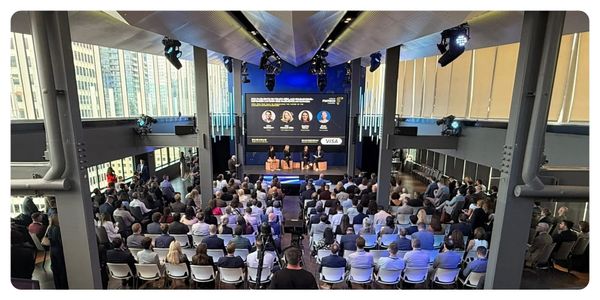
VivaTech at Ten: The Builders Are Still Building
VivaTech's 10th anniversary Decade Edition drew 200,000 visitors to Paris, debuted seven inaugural Bloomberg awards honoring the architects of the modern internet, and put hardware on stage that would have looked like science fiction five years ago. Here's what stood out.

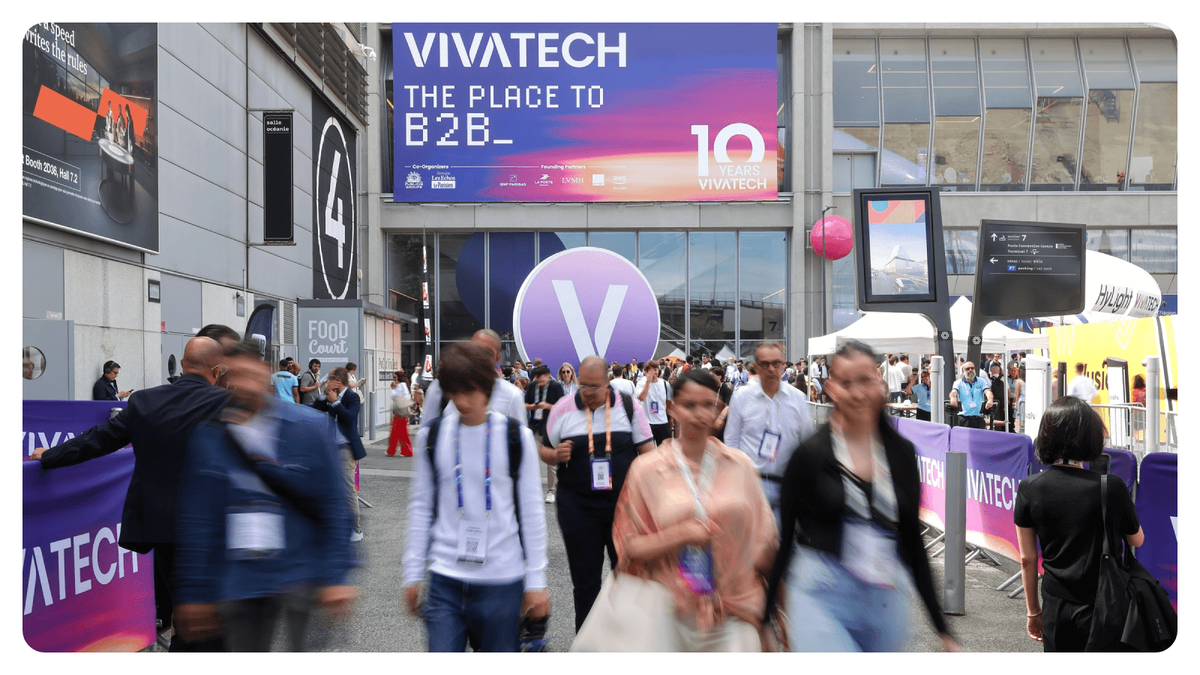
VivaTech's Decade Edition closed on June 20 as the largest in the event's ten-year history. The new Hall 7 at Paris Expo Porte de Versailles — 70,000 square metres across three floors, 30% more exhibition space than 2025 — doubled conference seating to 5,200 seats, and the edition also marked a formal name change: Viva Technology officially became VivaTech. More than 200,000 visitors and 15,000 startups attended across four days; Emmanuel Macron and Indian Prime Minister Narendra Modi both took the main stage, with Modi's presence underscoring India's designation as the official AI Country Partner. What the floor made clear was that the capital is moving, the platforms are being built, and the builders are increasingly based in Europe.
The VivaTech x Bloomberg Awards
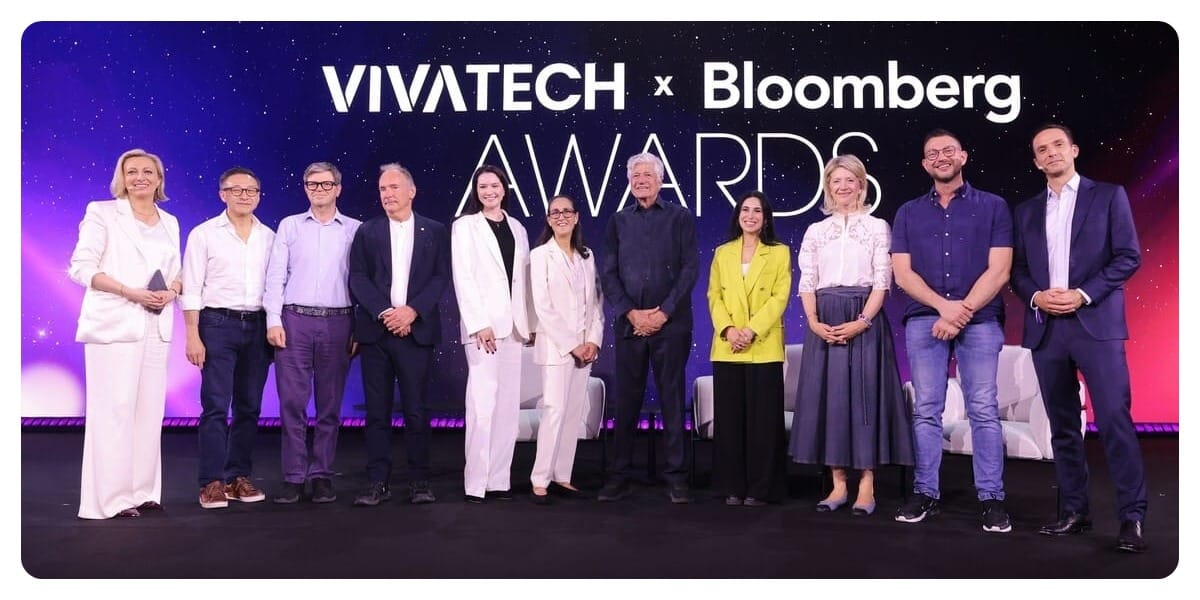
The 2026 edition debuted the VivaTech x Bloomberg Awards, a new recognition program honoring individuals whose decisions shaped the global technology economy. Seven awards were announced on June 18 at a ceremony hosted by Bloomberg Television's Francine Lacqua and Tom Mackenzie at the VivaTech Theater in the new Hall 7.
Visionary Award — Sir Tim Berners-Lee, inventor of the World Wide Web and Co-Founder & CTO of Inrupt. The Visionary Award recognizes lifetime achievement, and there was no ambiguity in this selection. Berners-Lee invented the infrastructure that made everything else possible, and Inrupt — his current venture — is working to restore individual control over personal data through the Solid protocol.
Leadership Award — Joe Tsai, Co-Founder & Chairman of Alibaba Group. The Leadership Award recognizes a senior leader whose stewardship is shaping the global tech economy. Tsai has guided Alibaba through significant regulatory and structural pressure while positioning the company as a foundation for AI and cloud infrastructure across Asia.
Momentum Award — Yann LeCun, Executive Chairman of AMI Labs. LeCun left his post as Chief AI Scientist at Meta earlier this year to co-found Advanced Machine Intelligence Labs, which raised a $1.03 billion seed round at a $3.5 billion valuation. AMI Labs is building world models as a structural alternative to large language models — a long-held position LeCun is now backing with capital at scale.
Breakthrough Award — Peter Steinberger, Creator of OpenClaw and Member of Technical Staff at OpenAI. Steinberger built OpenClaw, an open-source AI agent that became the fastest-growing project in GitHub history, crossing 302,000 stars by April 2026 and overtaking React, Vue.js, and TensorFlow in a fraction of the time. The project demonstrated that capable agents could be built and deployed by individuals rather than large research teams. OpenClaw now lives in an independent foundation; Steinberger joined OpenAI's Codex team to scale the next generation of personal agents.
Investor Award — Jeannette zu Fürstenberg, President & Managing Director of General Catalyst. The Investor Award recognizes capital and conviction that accelerated innovation. Zu Fürstenberg has led General Catalyst's European expansion and has been an active voice on the role of AI in healthcare and industrial transformation.
Rising Star Award — May Habib, Co-Founder & CEO of WRITER. WRITER builds enterprise-grade AI applications for large organizations — deployed with Fortune 500 clients at a time when most enterprise AI is still in pilot. Habib was nominated through a broad-based community process across the VivaTech and Bloomberg networks.
CitizenTech Award — Ukraine. The CitizenTech Award recognizes a city, country, or region using technology to make a real-world impact on citizens. Ukraine was recognized for maintaining essential public services through its digital infrastructure under wartime conditions. The award was collected by Natalia Denikeieva, Deputy Minister of Digital Transformation of Ukraine.
81.5% of founders now use AI for content. 58.7% say it doesn't sound like them.
They surveyed 92 founders to find out why — and what the ones who've cracked it are doing differently. Free report, no gate.
The Startup Prizes
VivaTech's own competition program handed out five awards on Stage One on June 19, MC'd by TechCrunch. These are the official VivaTech startup prizes — distinct from the Bloomberg leadership awards and the pavilion pitch battles.
Innovation of the Year — HODOR, founded by Karim Boussetta. HODOR builds the identity and permissions layer for AI agents — a gateway that controls exactly what each agent can access, at what rate, and with whose authorization. As companies plug agents into billing, CRM, and operations, the governance problem becomes acute; HODOR's answer is centralized identity assignment, real-time guardrails, and full audit logging across every agent action. Paris-based, backed by Hexa's Sprint program.
Tech for Change Award — Alithea Bio, founded by Fanny Giannou. The Freiburg-based biotech uses immunopeptidomics, mass spectrometry, and machine learning to identify neoepitopes — patient-specific cancer mutations — for precision immunotherapy. Its Neozoom platform targets those mutations directly with cancer vaccines and TCR-engineered T cell therapy, aiming to replace broad-spectrum treatment with something the immune system can actually recognize.
Female Founder Award — Endolith, founded by Liz Dennett, PhD. More than 70% of the world's copper sits in low-grade ores that conventional mining can't reach economically. Endolith trains naturally occurring microbes with AI to adapt in real time to those ores and extract the copper anyway. The company raised $16.5 million in Series A funding and operates labs in Arvada and Westminster, Colorado.
AfricaTech Award — SURGIA, founded by Ahmed Yahia. SURGIA is a digital supply marketplace that connects clinics and hospitals across Africa with medical supplies, combining smart inventory tracking, financing tools, and a regional delivery network. The platform has processed more than 151,000 orders across 45,000+ authenticated products, serving healthcare facilities including those in remote areas.
Next Startupper Challenge — AssisTech Foundation, represented by Sasha Ovalle. The inter-school and university competition was won by the ATF Smart Shower project — an assistive technology concept designed for users with limited mobility.
Pitch Battles & Demo Days
Beyond the Bloomberg Awards, VivaTech ran three distinct pitch competitions across its four days — none of which had publicly confirmed winners at the time of publication.
The Global Deep Tech Battles, hosted at the Swiss Pavilion, ran sector-specific rounds across six tracks: Robotics, AI, Space & Security, IoT & Smart Systems, CleanTech, and MedTech. The week closed with a live robot face-off between Swiss and French hardware teams on the pitch stage — less a formal competition than a demonstration of where autonomous hardware actually stands in 2026.
The DACH Pitching Contest brought together top startups from Germany, Austria, and Switzerland before a joint European investor panel. Germany served as the official Country of the Year, giving the DACH showcase a higher profile than prior editions.
At the HEC Paris Pitch Showcase, five startups from the HEC Challenge+ program — developed with INPI and WIPO — presented on the pitch studio stage on June 18. Two of them, FoxBio and HENDDU, are featured in the Standouts section below.

Standouts
XPANCEO [Hardware / Healthtech] — The Dubai-based deep tech company arrived at VivaTech fresh off a $250 million Series A at a $1.35 billion valuation — the largest Series A in the MENA region and the largest globally in AR/VR and wearables. Founded in 2021 by Roman Axelrod and physicist Dr. Valentyn Volkov, XPANCEO is building a screenless AR interface that sits directly on the eye, with current prototypes handling continuous glucose monitoring and glaucoma pressure tracking via tear fluid. Medical and industrial markets come first — aviation, surgical environments, space missions — with consumer wearables to follow. Full integration is targeted for early 2027.
Lattice Medical [Healthtech] — The French startup is in active clinical trials on MATTISSE, a 3D-printed resorbable scaffold for post-mastectomy breast reconstruction that uses a patient's own fat tissue and degrades completely within 18–24 months. The trial covers 50 patients across France, Spain, and Georgia; CE marking is targeted for 2026, which would open commercial deployment across Europe.
FoxBio [Biotech] — Founded in early 2025 by Sophie Blondel and Julie Gertner-Dardenne, FoxBio is developing CAR-Treg cell therapy for chronic inflammatory diseases, with Crohn's disease as the lead indication. The approach builds on 20 years of R&D from Sangamo Therapeutics, which demonstrated 80% efficacy in earlier studies. A €35 million fundraising round is currently underway.
HENDDU [Climate Tech / AI] — Founded by Dr. Soulemane Ngagine, a researcher with a PhD in atmospheric physics, HENDDU builds satellite and IoT-powered air quality monitoring systems for cities and governments across Africa. Its HOQA platform delivers real-time Air Quality Index readings, pollution hotspot mapping, and forecasting for public health decisions. Backed by ESA BIC NORD and Inria Startup Studio.
HABS [AI / Hardware] — The Paris-based startup ran a live brain-machine interface demo at VivaTech: visitors wore an EEG headset, concentrated on a song, and a Unitree humanoid robot identified the brain signal and pointed to the correct card. No implants, no invasive hardware. HABS recently signed a partnership with Microsoft to integrate its emotional sensing technology into Copilot.
Why It Matters for the UpNext Network
VivaTech's tenth edition assembled the architects of the current internet alongside the founders building its successor. LeCun left Meta to raise $1B on the thesis that world models are the path to machine intelligence. Berners-Lee is still working on data sovereignty at Inrupt, 35 years after inventing the web. At the demo stage, XPANCEO closed a $1.35B round on a lens that monitors glucose through tear fluid. European DeepTech funding reached a record €7.8 billion in 2025 (Dealroom), and the 2026 edition mapped where the next wave of that capital is being deployed: hardware, biotech, and AI infrastructure, with Europe as the primary theater.
Are you a founder, investor, or corporate partner active in deep tech? Join the UpNext directory to signal your intent and get on the radar of the next cohort.