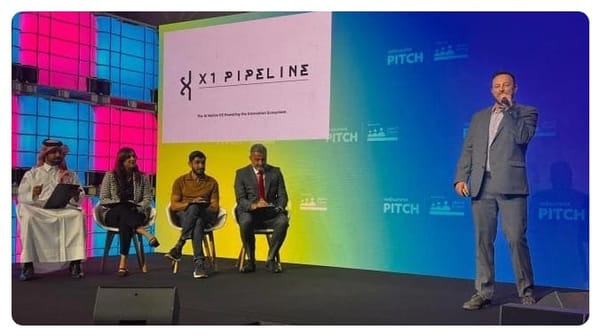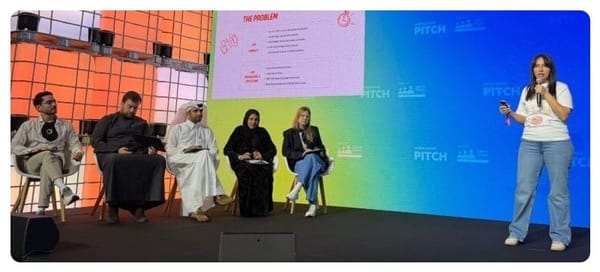
Web Summit Qatar PITCH 2026
A look inside the Web Summit Qatar PITCH 2026 finals—featuring the winner, the finalists, and the standout startups shaping what’s UpNext in tech.


The winner, finalists, and early signals shaping what’s UpNext in tech.
Web Summit Qatar had a different kind of intensity. Focused. Intentional. Conversations moved quickly, often skipping the small talk and getting straight to the work.
What stood out wasn’t scale for scale’s sake, but signal. Teams arrived clear on the problems they were solving and where they were headed next. You could feel the shift from idea-stage optimism to execution-driven ambition—especially in the rooms where early-stage founders were pressure-testing their thinking in real time.
And that’s where PITCH cut through. Not as a side attraction, but as a lens into what’s actually being built now. The teams that made it through stood out not just for how they pitched, but for the clarity, conviction, and readiness behind what they’re building.
Below is a closer look at the winner, the finalists, and a selection of startups that left a strong impression throughout the PITCH program.
PITCH Qatar 2026 - Winner & Finalists
This year’s PITCH competition surfaced a strong cross-section of technical founders tackling real, category-defining problems—from infrastructure and climate resilience to commerce, mobility, and applied AI. Only three teams advanced to the final round, each bringing a distinct and future-facing take on their market.
What stood out wasn’t hype, but execution. The finalists demonstrated clear problem definition, strong technical foundations, and a credible path to adoption—offering a snapshot of where early-stage innovation is heading next.
WINNER: Plantaform
Founder: Alberto Aguilar
Pitch:
Plantaform builds indoor growing systems powered by proprietary fogponics technology, enabling faster plant growth while using a fraction of the water required by traditional agriculture. By making hyper-fresh food possible anywhere, the company is addressing one of the most fragile aspects of the global food system: long supply chains, water scarcity, and the rising cost of fresh produce.
Originally designed for home use, the platform has evolved into a scalable solution spanning compact indoor units and commercial-grade systems adapted to, challenging environments.
What stood out:
A rare combination of deep technology and real-world deployment. Fogponics—originally developed by NASA for space cultivation—isn’t positioned here as novelty, but as infrastructure. Plantaform’s ability to scale the same core technology from kitchens to desert greenhouses signals long-term ambition beyond consumer hardware.
Traction:
Plantaform has generated over $1M in revenue across North America, with deployments in homes, schools, and major retail partners, including Costco. The company has received international recognition, including CES 2025 Best of Innovation and a deal on Dragons’ Den Season 19, and is now expanding into the GCC through pilot projects and commercial greenhouse initiatives.
Why they made the finals:
Plantaform is solving a global problem with local relevance. Alberto was clear about why water-scarce regions like the GCC represent a natural next market—and why the same platform can serve consumers, developers, and governments alike. It’s a vision rooted in food security, sustainability, and scale, backed by proven demand.
Finalist: &Again
Founder: Roanne El Alaili
Pitch:
&Again is a social commerce app for pre-loved and sustainable fashion—designed to make resale feel curated, social, and aspirational. Often described as Asos meets TikTok, but sustainable, the platform reframes second-hand shopping from a transactional marketplace into a culture-led experience built for Gen Z and millennial consumers.
Rather than focusing on guilt or climate messaging, &Again positions circular fashion as desirable, expressive, and community-driven.
What stood out:
A sharp understanding that behavior change in fashion doesn’t come from ethics alone—it comes from culture. Roanne is building resale around storytelling, influence, and identity, turning sustainability into something people want to participate in rather than feel obligated to support.
Traction:
The MVP launched in September 2025 and is already showing strong early momentum: 2,000 downloads, 800 sign-ups, and over 2,000 items listed. More than 400 items have been sold, generating ~200,000 AED in revenue. The platform is also building organic reach, with 2,000 Instagram followers and 14 influencers onboarded representing a combined audience of 10M+.
Why they made the finals:
&Again is tackling a massive global problem—fashion overproduction and textile waste—through a lens that fits the region and its consumers. Roanne’s approach blends social commerce, brand, and community to unlock circularity at scale, making her one of the more culturally attuned pitches in the competition.
Finalist: Glüxkind Technologies
Founder: Kevin Huang
Pitch:
Glüxkind is reinventing the stroller by applying AI and robotics to everyday parenting. Designed for modern urban families, the company’s flagship product delivers real-world assistance—reducing physical strain, improving safety, and easing the mental load of caring for young children.
Rather than adding surface-level “smart features,” Glüxkind positions the stroller as a co-pilot for parents, built to actively support mobility and safety in real environments.
What stood out:
A clear focus on assistance, not novelty. Kevin’s pitch emphasized practical, AI-driven mobility—push assist, braking support, and safety features that address real pain points parents face daily. It’s a rare example of robotics applied thoughtfully to consumer hardware, where trust and reliability matter more than spectacle.
Traction:
The product is already in market across seven countries, with strong early validation: two CES Innovation Awards, $9.5M in pre-orders following its debut at CES 2023, and two granted patents. This level of traction at a pre-seed stage signals both demand and execution capability.
Why they made the finals:
Glüxkind represents a shift from passive baby gear to intelligent mobility. Kevin articulated a long-term vision that extends beyond a single product—using AI to redefine how families move through cities. It’s a hardware-first company with platform-level ambition, backed by real customer pull.
Standout PITCH Startups
And while the finalists anchored the stage, the depth of talent across this year’s PITCH program was impressive. Many founders came in with clarity, conviction, and real progress.
Here is a selection of teams that stood out—whether through the problems they’re solving, the way they pitched, or the momentum they’re building.

Certean — Said Damoun
Pitch:
Certean uses AI to turn global regulatory compliance from a months-long consulting exercise into a clear, automated assessment. Instead of asking what a product is, Certean analyzes what it does—identifying all applicable regulations across markets before manufacturers sell, ship, or scale.
What stood out:
A fundamentally different way of thinking about compliance. By searching effect, Certean surfaces the hidden, horizontal regulations that traditional tools and consultants routinely miss—wireless components, batteries, lasers, sensors. The result is a system that scales with complexity, learns from every assessment, and turns regulatory risk into a repeatable, defensible process.
Fenestra — Shaun McCallum
Pitch:
Fenestra is a spatial AI canvas built for early-stage architectural design, helping architects turn sketches, CAD files, and rough 3D models into clear spatial visuals in seconds. It enables teams to communicate ideas earlier and faster—without disrupting existing workflows.
What stood out:
A sharp focus on the earliest and most under-supported phase of architectural work: idea communication. Fenestra doesn’t replace design tools—it accelerates understanding, reducing friction between architects, clients, and collaborators when clarity matters most.
Fincart — Mostafa Masry
Pitch:
Fincart is an operating system for e-commerce in emerging markets that unifies multi-courier shipping, cash collection, and customer delivery management on a single platform. Built for cash-on-delivery realities, it helps merchants sell more while saving time and money by replacing fragmented logistics and payments workflows with one integrated stack.
What stood out:
A clear understanding that logistics, cash reconciliation, and working capital are inseparable in emerging markets. Fincart’s end-to-end approach turns operational data into intelligence—powering routing, credit, and performance—something point solutions simply can’t do. The near-5× YoY growth, 95%+ retention, and zero marketing spend reinforce strong product-market fit.
Gig Engineer — Kirshen Naidoo
Pitch:
Gig Engineer enables companies to scale their core engineering teams on demand through an AI-powered, plug-and-play project-delivery platform. Built specifically for engineering workflows—not generic freelancing—it matches projects to vetted engineers and manages scope, contracts, payments, and delivery in a single digital workroom.
What stood out:
A clear focus on core engineering work and measurable efficiency gains. By addressing idle time, talent mismatch, and project-level delivery—rather than hourly staffing—Gig Engineer reframes workforce flexibility as an operational advantage for engineering-led enterprises, not just a cost play.
Intriq AI — Jess Liew
Pitch:
Intriq deploys autonomous AI agents for consultants across the full engagement lifecycle, with a particular strength in deep financial diagnosis. Unlike LLM-only tools, its agents write and execute code to analyze raw, messy financial data—allowing advisors to go deeper, faster, and with audit-ready accuracy. Early users are completing projects up to 58% faster.
What stood out:
A clear focus on where AI actually creates leverage in consulting: data preparation and financial analysis. Intriq’s code-executing agents move beyond surface-level summaries and into reproducible, verifiable diagnostics—addressing one of the most persistent time drains in corporate finance and transaction advisory work.
PromptGuard — Arouba Zubair
Pitch:
PromptGuard is the firewall for AI prompts—providing plug-and-play security, auditability, and cost control for GenAI applications and autonomous AI agents. It sits in front of the LLM, not inside it, enabling teams to block prompt injection, data leakage, unsafe actions, and runaway behavior in minutes.
What stood out:
A sharp reframing of prompts as the new security perimeter for AI systems. PromptGuard’s focus on speed, visibility, and enforceable boundaries speaks directly to real production risk—especially as AI agents and shadow AI proliferate faster than governance can keep up.
SEE — Abdelrahman Ghareeb
Pitch:
SEE is an AI-driven sports intelligence platform that turns any camera into a standardized athlete assessment tool. By translating movement into objective, repeatable performance metrics, SEE builds a 360° athlete profile—covering physical, skill, and psychological dimensions—without requiring labs, wearables, or expensive setups.
What stood out:
A strong push toward democratizing athlete evaluation. SEE replaces subjective scouting and intuition-driven development with accessible, data-backed insights, making consistent talent identification and progress tracking possible at scale—well beyond elite or professional environments.
SWAI.Ai — Mehrdad Sadraei
Pitch:
SWAI enables agencies to replace fragmented tool stacks with an autonomous execution layer—launching profitable campaigns at machine speed. Instead of copilots or workflow glue, SWAI delivers an Autonomous Revenue OS that compresses weeks of agency execution into minutes while dramatically reducing cost and manual input.
What stood out:
A clear diagnosis of margin collapse in the agency model—and a decisive architectural response. By eliminating prompt engineering, tool stitching, and human-in-the-loop bottlenecks, SWAI reframes AI from “assistance” to full-stack execution. The focus on data sovereignty and GCC-specific compliance signals strong regional intent and enterprise readiness.
Signals, Not Snapshots
PITCH is often framed as a competition. What matters more is what it reveals. The teams highlighted here reflect a broader shift toward clarity, execution, and category-level thinking—founders building with a strong sense of where their markets are headed, not just where they’re starting.
PITCH Qatar offered a clear snapshot of that momentum, surfacing builders moving from promise to proof. This is the kind of early signal we pay attention to.
Did we miss anyone?
Possibly. PITCH always moves faster than any single recap can capture. What’s documented here reflects the signal we observed—but some of the most interesting work often emerges just outside the spotlight.
We’ll continue tracking the founders and ideas that point to what’s UpNext.