TechCrunch Disrupt 2026: Lab-Grown Gut Tissue Wins the Battlefield Cup
Denver biotech Intero Biosystems won the $100,000 Startup Battlefield Cup at TechCrunch Disrupt 2026. Its lab-grown gut tissue beat 199 other companies.

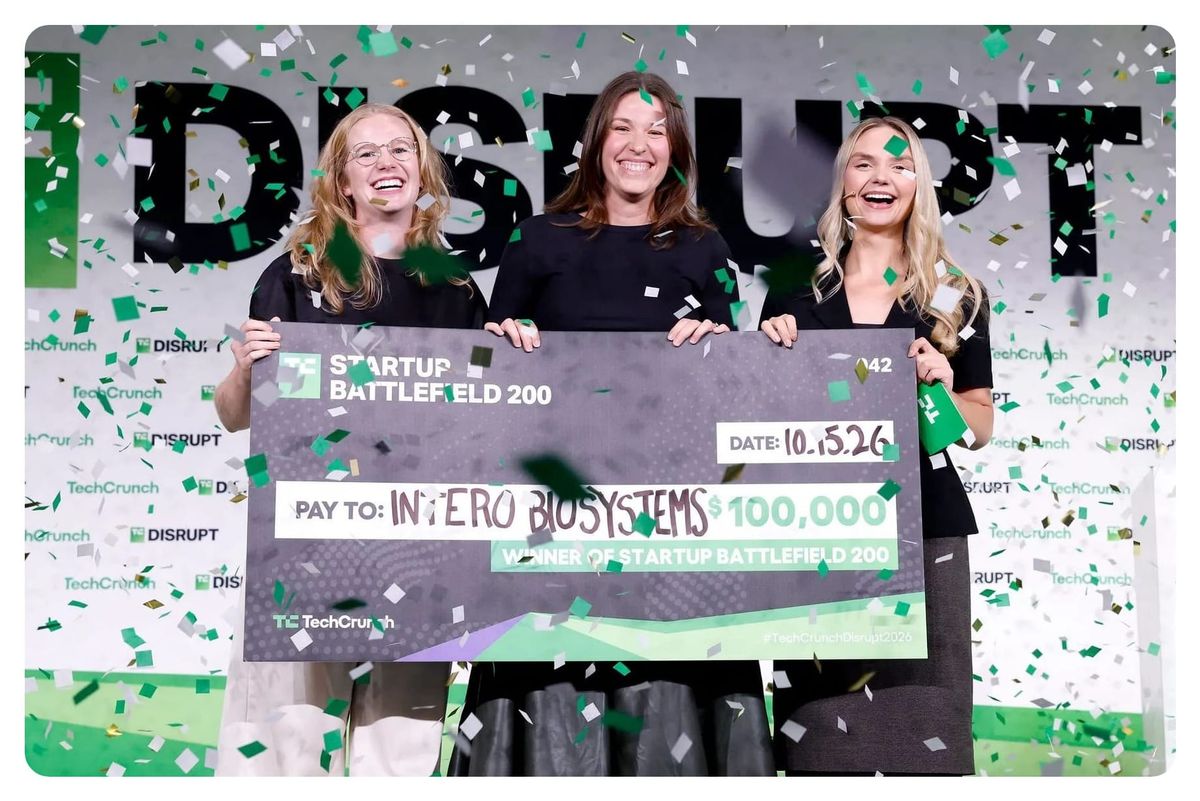
TechCrunch Disrupt 2026 ran October 13 to 15 at Moscone Center in San Francisco. Out of the 200 companies in the Startup Battlefield 200, 20 pitched over three days, and five reached the finals on the last day. The Top 20 spanned space, industrial AI, energy, health, and security. Five VCs judged the finals. TechCrunch put the crowd at more than 10,000 founders, investors, and tech leaders, with more than 320 startups in the Expo Hall.
81.5% of founders now use AI for content. 58.7% say it doesn't sound like them.
They surveyed 92 founders to find out why — and what the ones who've cracked it are doing differently. Free report, no gate.
The Startup Battlefield Cup Winner
Intero Biosystems [Biotech]
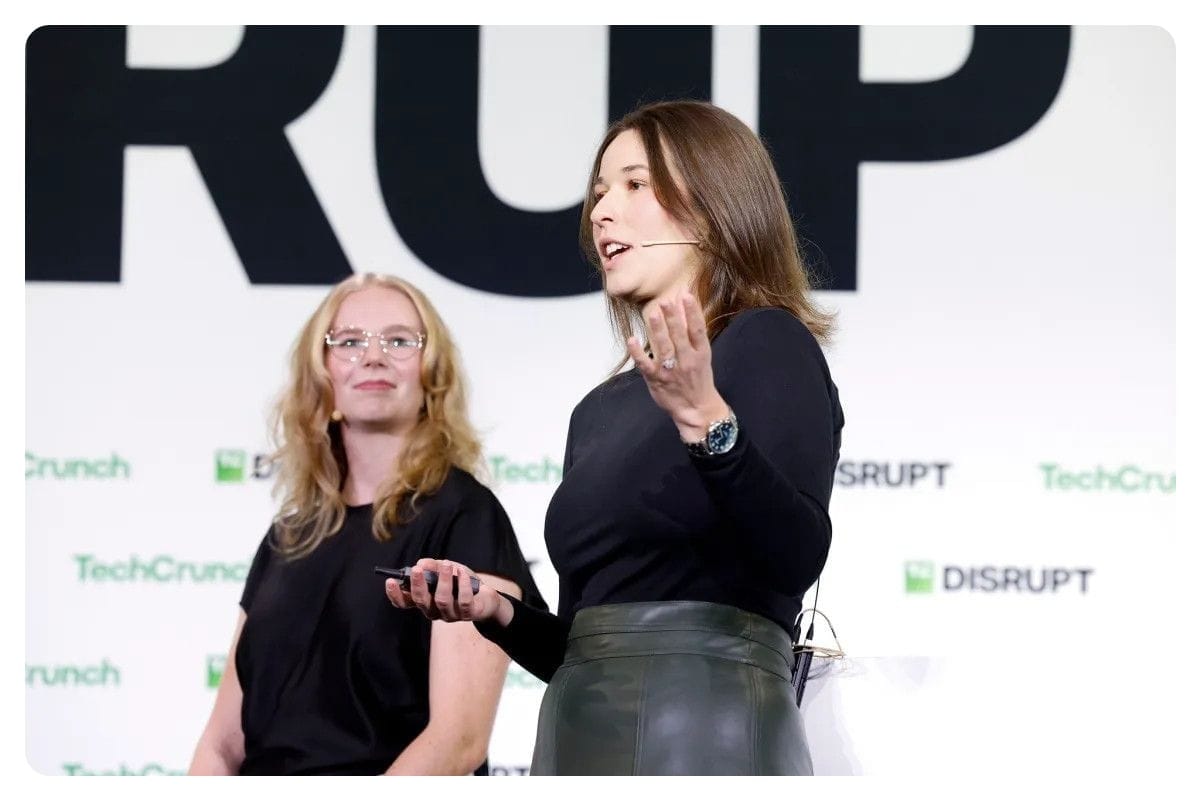
The Denver company won the Startup Battlefield Cup and the $100,000 prize. CEO Charlie Childs and CTO and COO Madeline Eiken spun it out of the University of Michigan in 2024. Intero also won the grand prize at the 2025 Rice Business Plan Competition. It grows human intestinal organoids about 1 millimeter wide from stem cells, and drug, biotech, food, and chemical companies use them to test how compounds affect the gut before human trials. The company sells them as GastroScreen and ships roughly 100 at a time. It raised a $2.3 million pre-seed round, has seven employees, and has just under 10 customers.
Childs says revenue topped $400,000 from Q4 of last year through Q3 of this year. He also says the product is in the second of three validation stages, and the third stage compares its results with pharma companies' animal and clinical data.
The Finalists
Apate [Cybersecurity] was the runner-up. Founder and CEO Dali Kaafar built it from research at Macquarie University in Sydney, and thousands of AI agents now pose as scam victims to gather intelligence for banks and telcos. Customers include Commonwealth Bank of Australia and TPG Telecom, and the company raised an $8.15 million seed round in August.
Flox Intelligence [AI] builds an edge device that keeps animals away from airports and railways. A motion sensor wakes it, an on-device camera identifies the animal, and it plays a sound meant to scare that species off. The goal is to prevent wildlife collisions.
Industrial Next [AI / Industrial] makes self-contained robotic stations run by its own foundation models. The company says a production line can be retooled in minutes instead of weeks with no traditional programming. Some of its workstations already help make a popular smartphone that TechCrunch did not name.
Satlyt [AI] writes software that lets satellites share large computing jobs in space. Operators can also sell idle onboard compute as virtual AI data centers. Satlyt has flown its software on two demonstration missions, and its next goal is a shared computing cloud between two satellites.
Running a pitch competition, accelerator or demo day?
UpNext produces editorial showcases for innovation centres, accelerators and trade agencies, putting your cohort in front of a network of 150,000+ founders, investors and innovation leaders, with a direct introduction channel to every company. Talk to us about your next cohort.
Standouts
Longshot Space [Hardware]. Hydrogen-powered kinetic launchers built to send cargo to orbit at lower cost.
Helix Carbon [Climate Tech]. Converts blast furnace waste gas at steel plants into replacement fossil fuels on site.
LNK Energies [Cleantech]. Compact reactors that make hydrogen power and work with existing diesel infrastructure.
Licube [Materials]. Makes ultra-high-purity lithium and lithium isotopes for fusion and advanced materials.
Niobia AI [AI / Industrial]. Domain-expert AI that speeds up root-cause analysis for process and materials engineers.
Laplace Intelligence [AI / Enterprise]. Agentic world models that simulate what-if scenarios for cities, ports, and airports.
TimeTeller [Biotech]. Molecular diagnostics and AI that measure a patient's biological clock so treatments can be timed.
Mosqitter [Healthtech]. Sensor networks that give early warning of mosquito-borne disease.
Hiyd AI [Healthtech]. A wearable and app that combine sleep, movement, and nutrition data.
Veritas [Consumer Tech]. Custom microchips that verify luxury goods and enable connected post-purchase experiences.
CedarDB [Enterprise Software]. A database engine that runs real-time transactions and analytics with safeguards AI agents cannot bypass.
Prismm [Fintech]. Automated inheritance workflows that help banks keep deposits across generations.
Floqer [AI / Enterprise]. Pulls B2B sales data from more than 80 sources into one customer timeline for AI agents.
GUDEA [AI / Enterprise]. Tracks how information spreads online so communication teams can see reputational risk. Founder Keith Presley says it was picked from more than 2,500 applicants worldwide.
NTangible [AI]. Cognitive scoring that helps coaches and front offices judge how athletes perform under pressure.
Why It Matters for the UpNext Network
The Top 20 pulled heavily from deep tech and physical-world companies, and the winner is a lab-grown product with under $1 million in revenue. Early customers and validation steps counted more on this stage than a polished software demo. Founders who want to follow the next cohort can find it all at upnext.world.